
A 12-step framework for how to plan an international trip: passports, flight timing, lodging, budget, insurance, and packing. Practical, US-traveler focused.
An international trip has roughly 12 moving parts, and most people forget 3 or 4 of them. The passport renewal that takes longer than expected. The credit card that hits you with a 3% foreign transaction fee on every coffee. The flight booked too early or too late. The 6-month-validity rule on your passport that nobody mentions until check-in.
This is a working framework for how to plan an international trip from scratch, ordered by what to do first and what to save for the week before you fly. Real US prices, real processing times, and the steps where a tool like Zenvoya compresses weeks of tab-juggling into one conversation. The framework holds for a first international trip, a family of four heading to Italy, or a couple stitching together a two-country honeymoon.
At a Glance
US passport processing: 4-6 weeks routine, 2-3 weeks expedited (US Department of State)
Six-month validity rule: Most countries require your passport to be valid 6 months past your return date
Schengen 90/180 rule: Americans can stay up to 90 days in any 180-day window across the Schengen area
TSA PreCheck: $80 for 5 years. Global Entry: $100 for 5 years (includes PreCheck)
Flight booking sweet spot: 10-12 weeks out for Europe, 12-16 weeks for Asia, 8-12 weeks for South America (Airlines Reporting Corporation booking data)
Travel insurance: 4-6% of total trip cost is the typical premium range for comprehensive coverage
First-time international planning: 8-14 hours of research becomes 20-45 minutes with an AI trip planner
Step 1: Pick the Destination (Realistically)
Most planning falls apart at step one because people pick a destination by Instagram, not by fit. A direct answer for the "where should we go" question: pick a destination that fits your travel dates, time budget, and group's energy. A 7-day window after 9 hours of flying does not work for a 4-city Europe trip. A summer trip to Greece in mid-July will be hot and packed.
A few sorting questions:
How many days do you really have? Subtract one day on each end for travel and jet lag. A "10-day trip" is usually 7-8 functional days on the ground.
What's your group's pace? Some people want 12,000 steps and 4 museums a day. Some want a balcony and a book. Mixed-pace groups need a destination with both.
Hot, cold, or shoulder? Northern Europe in June is gorgeous and busy. Same place in October is empty, half the price, and gray.
First international trip or experienced? A first international trip should be lower-friction: English-friendly, easy ground transport, good food without effort. Save Vietnam, Morocco, and India for later.
For starting points by season, look at best summer vacation destinations for 2026 for global picks, or best places to visit in the USA this summer for a domestic shoulder-season trip while passports renew.
Takeaway: Pick the destination before you fall in love with the photos. Match it to your time, energy, and weather tolerance.
Step 2: Set the Budget Framework
The second-most-skipped step. Setting an honest all-in budget number before booking anything saves more arguments and more wasted hours than any other single move.
A direct answer for the budget question: for two adults on a 7-day international trip, budget $3,500-6,500 for a mid-range Europe or Latin America trip including flights, $5,500-9,500 for mid-range Asia, and $8,500-15,000 for premium versions of either. For a family of four, roughly double the mid-range range. Include flights, lodging, food, activities, local transit, and a 10% buffer for the things you can't plan for.
International trip budget framework (per person, 7 days, all-in including flights):
Tier | Europe / Latin America | Asia | Notes |
|---|---|---|---|
Budget | $1,400-2,200 | $1,600-2,600 | Hostels or budget hotels, public transit, mostly counter-service meals, 1 paid activity per day |
Mid-range | $2,500-4,000 | $3,000-5,000 | 3-star hotels or mid-range vacation rentals, mix of transit and rideshare, 1-2 sit-down meals per day |
Premium | $5,000-9,000+ | $6,500-12,000+ | 4-5 star hotels, private transfers where useful, multi-course dinners, premium experiences |
Per-person all-in international trip budget by tier and region. Ranges drawn from Airlines Reporting Corporation booking data, Booking.com 2026 hotel averages, and the AAA Travel 2026 Family Travel Report.
These ranges assume reasonable choices, not bargain hunting or splurging. Flight prices alone can shift these by $400-800 per person depending on origin city and how far in advance you book. For a deeper walkthrough of the budget-then-destination order applied to summer trips, see how to plan a summer vacation.
Takeaway: Pick one all-in ceiling number. Every subsequent decision is a yes-or-no against that ceiling.

A budget on paper beats a budget in your head. Photo by Andrijana Bozic on Unsplash
Step 3: Get Your Documents in Order
The single most-skipped step on a first international trip. Documents are the longest lead-time piece of the entire plan, so they go first.
A direct answer for the documents question: check your passport's expiration date before booking flights. Most countries require it to be valid for 6 months past your return date. US passport processing is 4-6 weeks for routine renewal and 2-3 weeks for expedited (per US Department of State), so start the renewal the day you commit to the trip. Research visa requirements for your destination on the US State Department's country information pages or the destination country's embassy site.
Passport checklist:
Validity: Most countries enforce the 6-month rule. Schengen Europe requires 3 months past return, but airlines often refuse to board passengers without 6 months of validity. Treat 6 months as the default.
Blank pages: Most destinations require at least 2 blank visa pages. Older passports running out of room need to be renewed even if the expiration date looks fine.
Renewal timing: Apply 4-6 months out for routine processing. If you're inside 6 weeks, pay the expedited fee ($60 on top of the renewal cost) for 2-3 week processing.
Where to apply: travel.state.gov for US passport applications and renewals.
Visa research:
For US passport holders, the State Department's Country Information page lists visa requirements for every destination. The destination country's embassy site is the second source of truth. Common cases:
Schengen Europe: Visa-free for stays under 90 days in any 180-day window. ETIAS authorization (a paid online pre-screening) is rolling out for late 2026 onward; check status at travel-europe.europa.eu before booking.
UK: Visa-free for stays under 6 months. ETA (Electronic Travel Authorization) required for visa-exempt travelers; apply online before flying.
Japan, South Korea, Mexico, most of South America: Visa-free for short tourist stays.
China, India, Vietnam, Brazil: Visa required. Apply 6-8 weeks out minimum.
Trusted Traveler programs:
TSA PreCheck: $80 for 5 years. Faster domestic security.
Global Entry: $100 for 5 years. Faster US customs on return, includes PreCheck. The interview backlog can run 3-6 months, so apply early.
Mobile Passport Control: Free CBP app. Same speed boost as Global Entry on return, no interview required, works at most major US international airports.
Health: Check the CDC's Travel Health Notices page 8-12 weeks before departure. Some vaccines (yellow fever, Japanese encephalitis, typhoid) need multiple doses or take time to build immunity. A travel clinic visit runs $75-200 plus vaccine cost.
Takeaway: Documents are the long pole. Start them the day you commit to dates.
Step 4: Book Flights at the Right Time
Most flight regret comes from booking too early (overpaying because schedules and routes haven't settled) or too late (paying a panic premium in the final 3 weeks).
A direct answer for the flight booking question: book international flights 10-12 weeks before departure for Europe, 12-16 weeks for Asia and the South Pacific, and 8-12 weeks for South America and Central America. These windows produce the lowest median fares in Airlines Reporting Corporation booking data. Book Tuesday or Wednesday for slightly lower fares, though the day-of-week effect is smaller than it used to be.
Flight booking by region:
Europe: 10-12 weeks out. Push to 14-16 weeks for summer Mediterranean routes.
Asia (Japan, Korea, Thailand): 12-16 weeks. Long-haul fares stabilize earlier than short-haul.
Australia / New Zealand: 16-22 weeks. Limited routes mean inventory pressure is real.
South America: 8-12 weeks.
Central America and Mexico: 6-10 weeks for the Caribbean coast, 8-12 for the Pacific coast.
Tools: Google Flights is best for date exploration and price alerts. Skyscanner covers budget carriers in Europe and Asia. ITA Matrix is the power-user tool for complex routing. Zenvoya's flight booking often surfaces strong fares on premium cabins (business and first) that don't show up on the standard aggregators, which is useful if you're considering an upgrade. Always confirm final pricing on the airline's own site.
Free stopover hacks: Icelandair offers complimentary multi-day stopovers in Reykjavik on US-Europe routes. Turkish Airlines does the same for Istanbul. TAP Portugal does it for Lisbon. A useful way to bolt a bonus city onto a trip.
Takeaway: Book in your destination's region-specific window and set price alerts early.

A well-timed booking buys you this view at a reasonable price. Photo by Astra Liu on Unsplash
Step 5: Build the Itinerary (Without the Tab Hell)
This is where most plans die. You've got flights, you've got a vague idea of the destination, and then the itinerary sits as a blank Google Doc for three weeks while you open 47 tabs of guidebook articles and Reddit threads.
A direct answer for the itinerary question: build a day-by-day skeleton with 1-2 anchor activities per day, leave 2-3 hour blocks of unscheduled time, and book restaurants only for meals you really care about. A 7-day international trip should have 7-10 fixed bookings, not 30. The rest is on-the-ground decisions.
The old way: a Pinterest board, three competing Google Sheets, WhatsApp recommendations from 2019, and a compromised itinerary nobody loves.
The newer way uses an AI trip planner. Tools like Zenvoya take a natural conversation ("Two adults plus a 9-year-old, 8 days in Italy in late June, Rome plus the Amalfi Coast, mid-range hotels, budget around $7,000 not counting flights, kid likes pasta and ruins") and produce a day-by-day plan with timing, reservations, and transport accounted for. You push back, it adjusts. Zenvoya books flights, hotels, and activities directly. For ferries, intra-country transport, and rental cars, it'll plan timing and routes around them (book those on the operator sites).
For group trips, Zenvoya's collaborative planning helps the most. Share the working itinerary with everyone going, collect their picks and edits in one place, and have the personalization factor in each person's preferences. It replaces the three competing WhatsApp threads, the lone Google Doc nobody updates, and the inevitable scramble the night before to reconcile what everyone actually wants.
Time savings are real. Traditional research for a new international destination runs 8-14 hours; a focused AI-planner conversation compresses that to 20-45 minutes for the first usable draft. You still refine and add your own opinions. The blank-page problem disappears.
A good first-international-trip itinerary: 1-2 anchor activities per day, a rest afternoon around day 3 or 4 (jet lag catches up), reservations for 2-3 meals across the week, transit time blocked out honestly, and one "nothing planned" slot for the thing you'll discover.
Takeaway: Fix the anchors. Leave the rest loose. Over-planning kills a trip as fast as under-planning.
Step 6: Lock In Lodging
Once flights and the rough itinerary are set, lodging is the next big decision. There are two failure modes: booking too early before you know which neighborhood you actually want, and booking too late after the best mid-range options sell out.
A direct answer for the lodging question: book hotels 6-8 weeks out for most international destinations, and 4-6 months ahead for peak-season Mediterranean, Greek Islands, Iceland, Japanese cherry blossom season, and other capacity-constrained windows. Use vacation rentals (Airbnb, Vrbo) for groups of 4+ or stays longer than 7 nights; use hotels for shorter city stops.
Hotels vs. vacation rentals: Hotels win for city centers, 1-3 night stays, trips with lots of movement, families with one kid, and anyone who doesn't want to cook. Rentals win for groups of 4+, stays longer than 5 nights, destinations where eating out 3x daily breaks the budget, and families with multiple kids on different sleep schedules. On the hotel side, newer platforms like Super.com and Zenvoya's hotel booking regularly surface 30-40% savings versus the big aggregators on the same room. Worth a comparison check before locking in a rate.
For destination-specific lodging guidance, the Greek Islands itinerary walks through trade-offs by island, and the family summer vacation planning guide has the family-of-four version.
Cancellation policy: Many international hotels have free cancellation up to 24-48 hours before arrival. Book early at flexible rates, then re-check pricing 4-6 weeks out and re-book if it's dropped meaningfully. Don't book non-refundable rates more than 8 weeks out unless savings are 25%+.
Takeaway: Book early at flexible rates. Re-shop 4-6 weeks out.
Step 7: Plan Ground Transportation
Ground transport inside the destination country is where most first-time international travelers underestimate cost and complexity. A direct answer: research train networks first (most of Europe and Japan), then car rental if the trip is rural or multi-region, then domestic flights for long distances inside large countries. Pre-book intra-country trains in Europe and Japan 4-6 weeks out for the best prices.
Region by region:
Europe: Trains are usually faster door-to-door than flying for distances under 700 km. Book Eurostar, TGV, Trenitalia, and Renfe high-speed trains 4-6 weeks out. For Italy specifics, see how to get around Italy.
Japan: Rail is the default. The Japan transportation guide covers when to buy a JR Pass and when to skip it.
Greek Islands and Mediterranean: Ferries. Use Ferryhopper to compare schedules and book; popular summer routes (Santorini to Mykonos, Mykonos to Naxos) need to be booked 4-6 weeks out for peak weeks.
Iceland: Self-drive is the default. The ring road takes 7-10 days at a comfortable pace. See how to get around Iceland for buses, tours, and the case for skipping a rental.
Mexico, Central America, parts of South America: Domestic flights (Aeroméxico, Avianca, LATAM) for distance. Long-distance buses (ADO, Pullman) for shorter hops.
Southeast Asia: Overnight trains, budget flights (AirAsia, VietJet), and the occasional ferry.
Takeaway: Research transport before locking the itinerary. A 5-hour train changes pace differently than a 1.5-hour flight.

Three hours early at the international terminal is rarely the wrong call. Photo by Fabio Sasso on Unsplash
Step 8: Buy Travel Insurance (When It's Worth It)
A direct answer for the travel insurance question: if your trip cost is over $5,000 per person, comprehensive travel insurance covering medical and trip cancellation is a strong yes. If your trip cost is under $1,500 per person and you have decent health insurance, it's often not worth it. The typical premium is 4-6% of trip cost. International medical coverage is the most important component; trip cancellation is secondary.
Independent brokers like SquareMouth and InsureMyTrip let you compare 15-20 carriers on one site. Avoid buying through airlines and OTAs at checkout; those policies tend to be both more expensive and less comprehensive than what you can find through a broker.
Insurance is clearly worth it if: trip cost is over $5,000 per person, you're going somewhere US health insurance won't cover (almost everywhere outside the US), you've paid non-refundable rates far in advance, the trip involves adventure activities (climbing, scuba, motorbiking), or you have older parents who might create a cancellation reason.
Often skippable if: trip cost is under $1,500 per person and mostly refundable, you have strong primary health insurance with some international medical, and you're going somewhere with good affordable healthcare (parts of Europe, Japan, Taiwan).
The $75-150 premium for a 7-day Europe trip is a fraction of what an unplanned emergency room visit costs out of pocket internationally.
Takeaway: Match insurance to risk and trip cost. Use an independent broker like SquareMouth or InsureMyTrip.
Step 9: Notify Banks and Set Up International Money
A direct answer for the international money question: get one credit card with no foreign transaction fees as your primary, one debit card with no foreign ATM fees as your backup for cash, and notify both banks of travel dates 1-2 weeks before departure. Carry small amounts of cash for tips and taxi fallbacks; use cards for everything else.
Best cards for international travel (no foreign transaction fees):
Chase Sapphire Preferred / Reserve: No FX fees, strong built-in travel insurance, good rewards on travel and dining.
Capital One Venture / Venture X: No FX fees, simple flat-rate rewards.
Schwab Bank High Yield Investor Checking: Debit card with no foreign ATM fees and worldwide ATM fee reimbursement. The single most useful international banking move.
Wise (formerly TransferWise) debit card: Multi-currency, very low FX margins, useful for longer trips.
Money setup before you leave: Notify each card issuer of travel dates (60-second app task). Order $100-200 in local currency 2 weeks ahead for arrival-day taxis and tips. Skip airport currency exchange (worst rates). Save your bank's international fraud-line number for the inevitable card lock.
Takeaway: One no-FX-fee credit card, one no-fee debit card for ATM cash, notify both banks before departure.
Step 10: Pack Smart for International Travel
International packing differs from domestic in three specific ways: power adapter requirements, harder-to-replace prescription medications, and the importance of carry-on essentials when checked bags get lost across an international transfer.
A direct answer for the packing question: pack a 5-7 day climate-appropriate capsule in a single carry-on if possible. Always carry on medications in original prescription bottles, two days of clothes, charging cables, the right power adapter for your destination, and a printed copy of your passport. Check bigger items only if you'd be okay with them arriving 48 hours late.
Power adapter cheat sheet (US travelers):
Europe (most of): Type C/E/F (two round pins). 230V outlets, so check device labels for "100-240V" compatibility (most laptops, phones, cameras are fine).
UK and Ireland: Type G (three rectangular pins).
Japan: Type A (same as US, 100V). No adapter needed for most US devices.
Australia, parts of South America, China: Type I or universal adapter recommended.
Carry-on essentials (never in checked): medications in original labeled bottles plus a prescription copy, phone and laptop with chargers, destination adapter, one change of clothes for bag-delay scenarios, printed copy of passport and hotel confirmation, earplugs and sleep mask, refillable water bottle (empty through security, fill at the gate).
Packing tips: Layers beat bulk (a merino base plus a packable shell handles most ranges). Two pairs of shoes max. Pack one nicer-dinner outfit; international cities skew dressier than US ones. Solid-form toiletries (shampoo bars, toothpaste tabs) saves the liquid hassle.
Takeaway: Carry-on essentials cover the worst case. A thoughtful capsule beats overpacking.
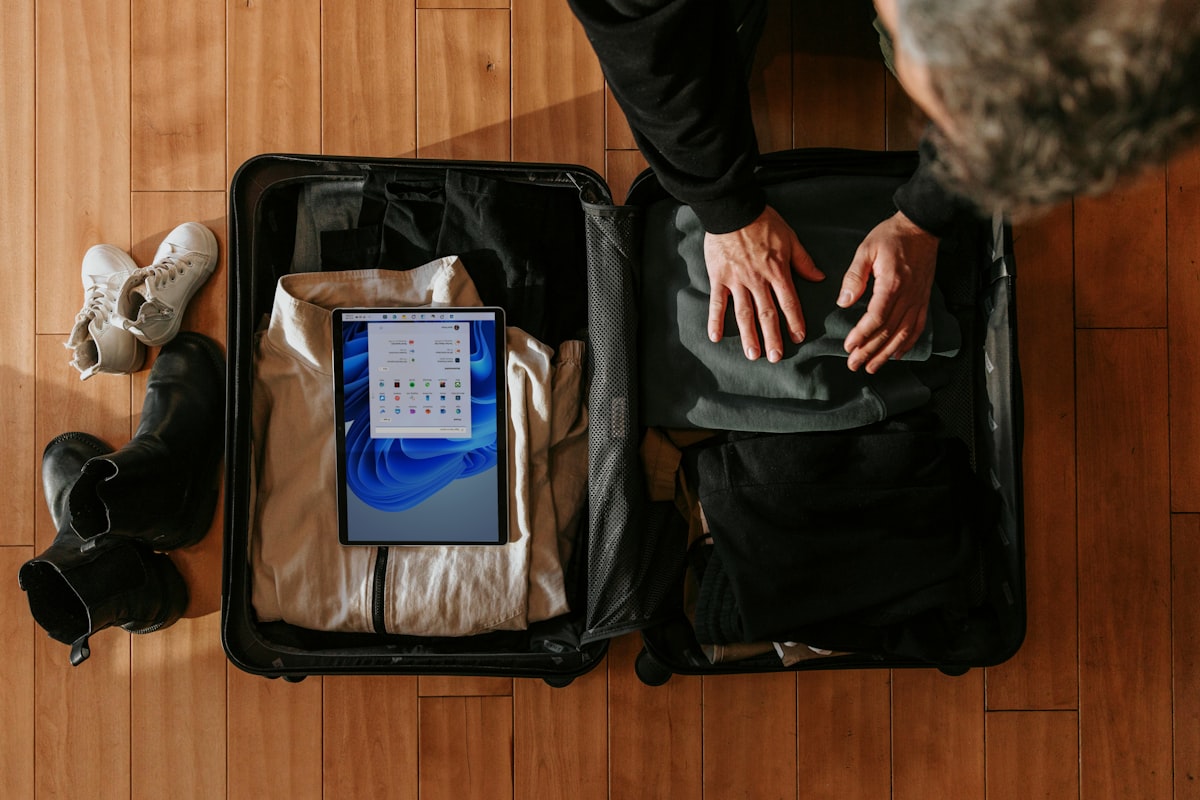
Pack the day before, not the morning of. Photo by Surface on Unsplash
Step 11: The Day Before and Day Of
The last 48 hours are when small misses become big problems.
Day-before checklist: Check passport expiration one more time (confirm 6 months past return). Confirm flight time (airlines occasionally shift in the final week). Download offline Google Maps for your destination city. Download a translation app (Google Translate, DeepL) with offline language packs. Add a currency converter (XE Currency). Check destination weather and adjust the top of your bag. Confirm airport transport on both ends. Charge everything: phone, laptop, headphones, portable battery. Print a paper copy of your itinerary, hotel addresses, and emergency contacts. Phones die; paper doesn't.
Day-of: Arrive 3 hours before international departure (longer at busy US hubs: JFK, LAX, MIA). Keep your passport, boarding pass, and a credit card in one accessible pocket. Drink water on the plane; skip alcohol on long-hauls.
Takeaway: A 30-minute day-before checklist catches what causes panic at the gate.
Step 12: Build a Quick Re-Plan System
Most international trips have at least one small thing go sideways. The travelers who handle it well prep for it. A direct answer: take photos of your passport, boarding pass, hotel confirmations, and insurance card and store them in cloud storage with offline access. Save your bank's international fraud number, your insurance emergency line, and the nearest US embassy phone number before you fly.
Build the kit: Cloud-storage copies of passport, visa pages, boarding pass, hotel confirmations, and insurance card. Email yourself the same documents as a backup. Save the US embassy or consulate in your destination country to your contacts. Save your insurer's 24/7 assistance line; it's the number to call before paying for any foreign hospital visit. Set up airline app delay alerts.
If something goes wrong: Cancelled flight: rebook through the airline app first (usually fastest), then call, then go to the counter. Lost bag: file the claim at the destination airport before leaving the baggage area; keep replacement receipts. Medical issue: call insurance's 24/7 line first. Stolen passport: go to the US embassy or consulate for an emergency replacement (1-3 business days in most cases).
Takeaway: 20 minutes of disruption-kit prep pays off the one time something goes wrong.
Timeline at a Glance
Time Out | What to Do | Notes |
|---|---|---|
6-12 months | Passport check and renewal, destination picked, dates locked, all-in budget set | Renew passport if validity is under 9 months past return |
3-4 months | Book international flights, research visa requirements, apply for visas if needed | Use the region-specific booking window from Step 4 |
6-8 weeks | Book hotels and vacation rentals, book intra-country trains and ferries, start CDC vaccine check | Book at flexible rates; re-shop 4 weeks out |
4-6 weeks | Build itinerary, reserve must-do restaurants, buy travel insurance | Use an AI planner like Zenvoya for the first-draft itinerary |
2 weeks | Pack a draft suitcase, notify banks, order foreign currency, download offline maps | Confirm passport validity one more time |
1 day | Print itinerary, charge everything, confirm flight time, set out clothes | The 30-minute checklist that prevents 90% of gate-side panic |
Timeline assembled from US Department of State passport processing windows, Airlines Reporting Corporation booking data, and CDC Travel Health vaccine guidance.
Ready to Plan Your Next Trip?
A working framework cuts the research time, but the actual itinerary still has to come together. Start a conversation with Zenvoya and describe the trip you want, including dates, destinations, group size, and budget. The first usable draft takes 20-45 minutes instead of two weekends, and you can refine from there.