
How to get around Italy by Trenitalia and Italo high-speed train, regional rail, vaporetto in Venice, ferries to Sicily, and when to rent a car. Real euro prices.
The easiest way to get around Italy is by train. The high-speed network connects most major cities in 1-3 hours, regional trains fill in the gaps for under €15, and renting a car inside Rome, Florence, Milan, or Venice is a fast track to a €100+ ZTL fine. Save the car for Tuscany back roads, Puglia, and the interior of Sicily and Sardinia.
Italy is one of the most train-friendly countries on the planet. The country has 70+ high-speed rail stations, two competing operators (Trenitalia and Italo) racing each other on the same tracks, and a regional network that reaches villages tourist coaches never see. After helping travelers route their Italy trips through Zenvoya, we see the same mistake on repeat: people book a rental car for the whole trip, then spend the first three days circling Roman one-way streets looking for parking that does not exist. Here is how to get around Italy by transport mode, with real euro pricing and an honest take on when a car actually helps.
Italy Transport at a Glance
Fastest option: Frecciarossa high-speed rail. Top speed 300 km/h, Rome to Florence in 1 hour 30 minutes covering 261 km.
Two high-speed operators: Trenitalia (state-owned, runs Frecciarossa) and Italo (private). They share the same tracks on most main lines.
Cheapest intercity option: Regional trains. Rome to Tivoli for €4, Florence to Pisa for €10, no booking required.
Drive at your peril in cities: Rome, Florence, Milan, Bologna, Naples, and most historic centers have ZTL zones (Zona a Traffico Limitato). Driving in unannounced earns an automatic €80-150 fine.
Ferries: Italy to Sicily, mainland to Capri or Ischia, and Amalfi Coast hops run through Caremar, Snav, and Liberty Lines. Book through Ferryhopper or directly with the operator.
How Does Italy's Train System Actually Work?
Italy runs Europe's third-largest rail network by passenger volume, with roughly 16,800 km of track managed by Rete Ferroviaria Italiana, per the Italian Ministry of Infrastructure and Transport. Two operators run service: Trenitalia (state-owned, legacy) and Italo (private, launched 2012, ~25% of high-speed routes). They share most tracks. They do not share booking platforms.
Italian trains come in three speed tiers. Pick the wrong one and a 90-minute trip becomes three hours.
Italy Train Tiers: Complete Comparison
Tier | Operator | Speed | Typical Route | Booking Required | Price Range |
|---|---|---|---|---|---|
Frecciarossa / Italo AGV | Trenitalia / Italo | 250-300 km/h | Rome-Florence-Milan-Venice-Naples corridor | Yes, reserved seat | €25-90 |
Frecciargento / Frecciabianca | Trenitalia | 200-250 km/h | Rome to Lecce, Venice to Bari, secondary corridors | Yes, reserved seat | €30-70 |
Intercity (IC) | Trenitalia | 130-200 km/h | North-south overnight, slower mainline routes | Yes, reserved seat | €20-50 |
Regionale Veloce (RV) | Trenitalia | 100-160 km/h | Florence-Pisa, Rome-Naples coastal, Cinque Terre | No, hop on | €5-25 |
Regionale (R) | Trenitalia | 80-120 km/h | Local stops, suburban service | No, hop on | €3-15 |
Sources: Trenitalia and Italo published fares, verified against Italian Ministry of Transport rail statistics. Prices reflect advance booking on standard class.
Frecciarossa and Italo AGV trains are the tourist workhorses, covering the spine of the country (Turin, Milan, Bologna, Florence, Rome, Naples, Salerno) plus Venice and Verona branches, station-center to station-center.
Trenitalia vs Italo: Which High-Speed Train Should You Book?
Book whichever is cheaper on your date. The trains share the same tracks, journey times are nearly identical, and the comfort difference is minor. Italo is typically 10-20% cheaper for advance bookings; Trenitalia has more frequent departures and broader coverage to smaller cities.
Trenitalia (Frecciarossa) vs Italo: Head-to-Head
Factor | Trenitalia Frecciarossa | Italo |
|---|---|---|
Top speed | 300 km/h | 300 km/h (AGV trains) |
Daily departures Rome-Milan | ~50 | ~30 |
Daily departures Rome-Florence | ~70 | ~45 |
Route coverage | All major HSR cities plus Reggio Calabria, Lecce, Salerno, Trieste | Turin to Naples spine plus Venice, Verona, Bologna, Salerno (no Sicily, no Lecce) |
Standard class name | Standard | Smart |
Premium class name | Business / Executive | Prima / Club Executive |
Wi-Fi | Free on all trains | Free on all trains |
Luggage | 2 large bags free | 2 large bags free |
Typical advance fare (Rome-Florence) | €30-50 | €25-45 |
Typical advance fare (Rome-Milan) | €50-90 | €40-80 |
Last-minute fare (same route) | €70-120 | €60-100 |
Booking app | Trenitalia (iOS / Android) | Italo Treno (iOS / Android) |
Trenitalia vs Italo prices reflect 2-4 week advance bookings on standard fare class. Both operators run dynamic pricing similar to budget airlines. Sources: Trenitalia and Italo official booking platforms.
Booking rule: book at least 14 days out. Same-day Frecciarossa tickets routinely cost 2-3x advance fare. The cheapest "Super Economy" tiers are non-refundable but usually worth the savings.
Cross-shop both apps. Trenitalia does not show Italo and vice versa. Search the same route on both, book whichever is cheaper. Trainline (UK aggregator) shows both for a small fee.
Regional Trains: When to Use Them, When to Skip
Regional trains are the unsung hero of Italian travel: slow, stopping everywhere, costing a fraction of high-speed fares. For trips under 100 km or to destinations Frecciarossa skips, regional is the answer.
Use regional for routes under 100 km (Florence to Pisa, Rome to Tivoli, Naples to Sorrento, Venice to Padua) and for Cinque Terre, the Amalfi outskirts, Tuscan hill towns, or Sicily's interior. Skip regional when your route exceeds 150 km and a Frecciarossa exists (Rome-Florence by regional takes 3.5 hours vs 90 minutes by Freccia).
Regional Train Routes Worth Knowing
Route | Distance | Time | Cost | Why You'd Take It |
|---|---|---|---|---|
Florence to Pisa | 81 km | 1 hour | €10 | Leaning tower day trip |
Rome to Tivoli | 32 km | 1 hour | €4 | Villa d'Este and Hadrian's Villa |
Naples to Sorrento | 49 km | 1h 10min | €4.90 (Circumvesuviana) | Pompeii and the Amalfi gateway |
Venice to Padua | 37 km | 25-50 min | €4.40 | Scrovegni Chapel |
La Spezia to Monterosso | 26 km | 22 min | €5 | Cinque Terre entry point |
Florence to Lucca | 80 km | 1h 25min | €9 | Underrated walled city |
Milan to Como | 50 km | 35-60 min | €5.20 | Lake Como day trip |
Regional train Italy fares set by Trenitalia, verified January 2026. The Campania Express, a tourist regional service to Pompeii and Sorrento, charges premium fares of €15-20 one-way.
Regional quirk: validate paper tickets in the green or yellow platform machines before boarding. Skipping earns a €50 fine even with a valid ticket. The mobile app validates automatically.
How to Get Around Rome, Italy: Metro, Walking, and Why to Skip Driving
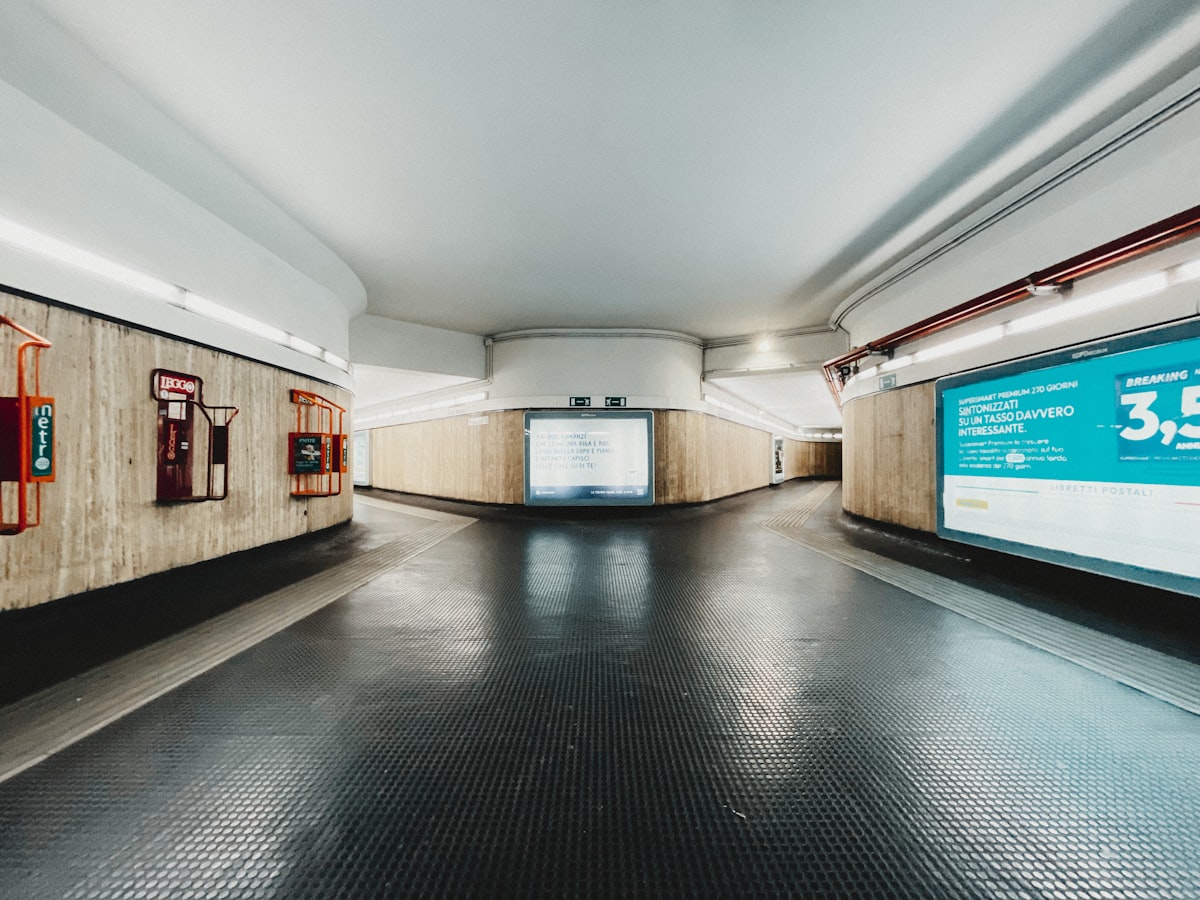
Rome Metro Line C platform on a quiet weekday morning. Photo by Tuna Ekici on Unsplash
The single most important thing about getting around Rome, Italy: do not rent a car. The historic center is a Limited Traffic Zone (ZTL) monitored by cameras, with €80-150 fines for unauthorized entry. Streets that look like normal roads on Google Maps are often pedestrian-only.
Metro: three lines, A (red), B (blue), and the newer C (green). Lines A and B intersect at Termini. The system is small (60 km, 73 stations) but covers the tourist core: Vatican (Ottaviano), Spanish Steps (Spagna), Colosseum (Colosseo), Roma Termini for trains. Single ride €1.50, valid 100 minutes including bus transfers.
Buses fill the gaps. Rome's bus network is extensive but slow. Express electric routes (label "E") are faster. Skip the hop-on-hop-off tourist buses; regular city buses cover the same routes for €1.50.
Walking is often fastest. Trevi Fountain to Pantheon is a 10-minute walk. The historic center is more compact than it looks.
Taxis and ride-hailing. Uber operates in Rome but only with licensed taxi drivers (Uber Black tier), same price as flagging a cab. Airport flat fare is €50 from Fiumicino, €30 from Ciampino, set by city ordinance.
Rome Transport Passes Compared
Pass | Cost | Duration | Best For |
|---|---|---|---|
Single ride (BIT) | €1.50 | 100 minutes | One-off rides |
24-hour pass | €7 | 24 hours | Two-day visitors |
48-hour pass | €12.50 | 48 hours | Sightseeing-heavy weekend |
72-hour pass | €18 | 72 hours | Long weekend |
Weekly (CIS) | €24 | 7 days | Week-plus stays |
Roma Pass (48h or 72h) | €36 / €58 | 48 / 72 hours | Includes 1-2 museum entries + skip-line at Colosseum |
Rome transport pass prices set by ATAC, verified January 2026. Tickets are interchangeable across metro, bus, tram, and most urban rail.
Roma Pass break-even: the 72-hour pass at €58 includes the first two museums or sites plus skip-the-line at the Colosseum. The Colosseum, Roman Forum, and Palatine combined ticket alone is €18 with timed entry that books out 2-3 weeks ahead.
How to Get Around Florence: Walking-First, Tuscany Drives After
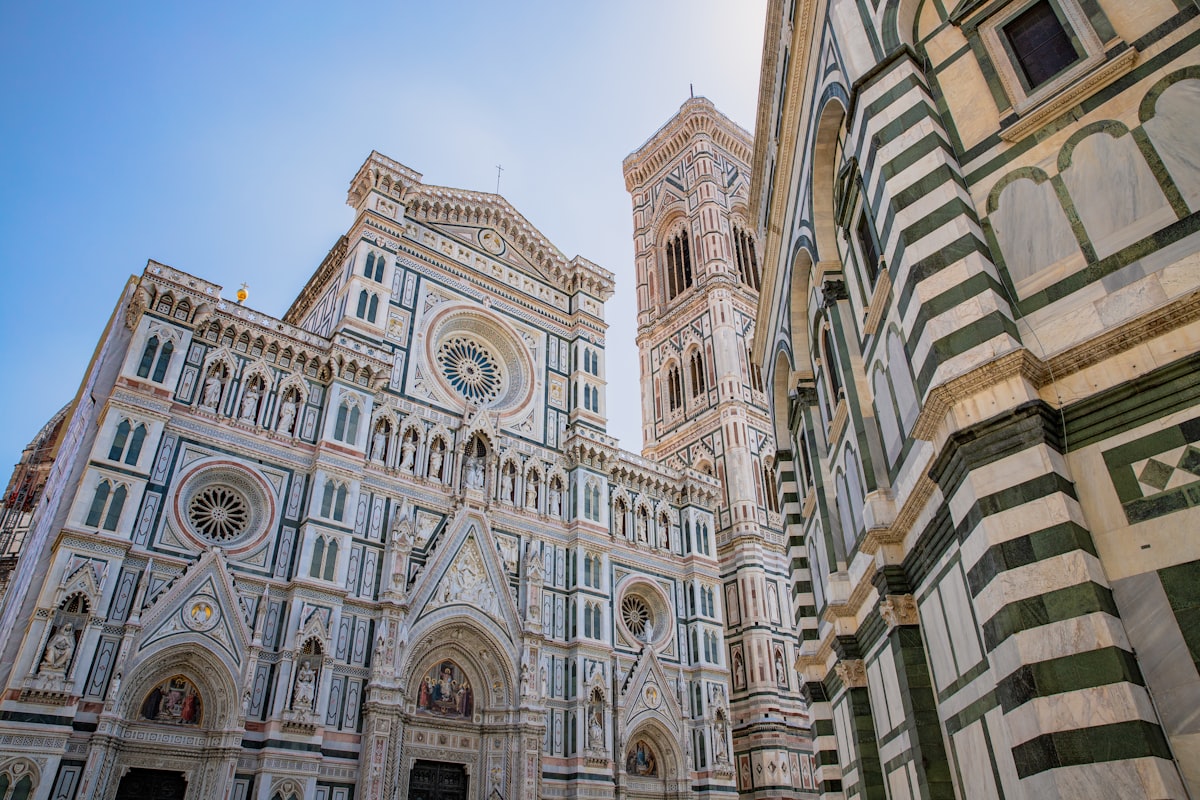
Florence Duomo from above, with the bell tower in foreground. Photo by Alexandra Smielova on Unsplash
Florence is the most walkable major city in Italy. The historic core is barely 2 km across, and driving inside is even worse than Rome. The city's enormous ZTL covers essentially the entire tourist area, monitored 24/7.
Walk first. Firenze Santa Maria Novella (Firenze SMN) to the Duomo is a 10-minute walk. To the Ponte Vecchio, 15 minutes. To the Uffizi, 12 minutes.
Local buses (ATAF) cover the outskirts. Bus 12 or 13 from Firenze SMN to Piazzale Michelangelo for sunset, Bus 7 to Fiesole. A 90-minute ticket is €1.70 at a tabaccheria, €2 from the driver. Florence has no metro.
Trams. T2 runs from the airport directly to Firenze SMN. The €1.70 ticket beats the €25 taxi fare.
When to rent a car (Florence-based): for classic Tuscany day trips (San Gimignano, Chianti, Volterra, Montalcino, Pienza, Montepulciano). Pick it up at the airport or a rental office outside the ZTL, drive straight out, never bring the car back inside. Expect €40-70 per day for a compact in shoulder season, €60-90 peak summer.
How to Get Around Venice, Italy: Vaporetto and Walking, Period
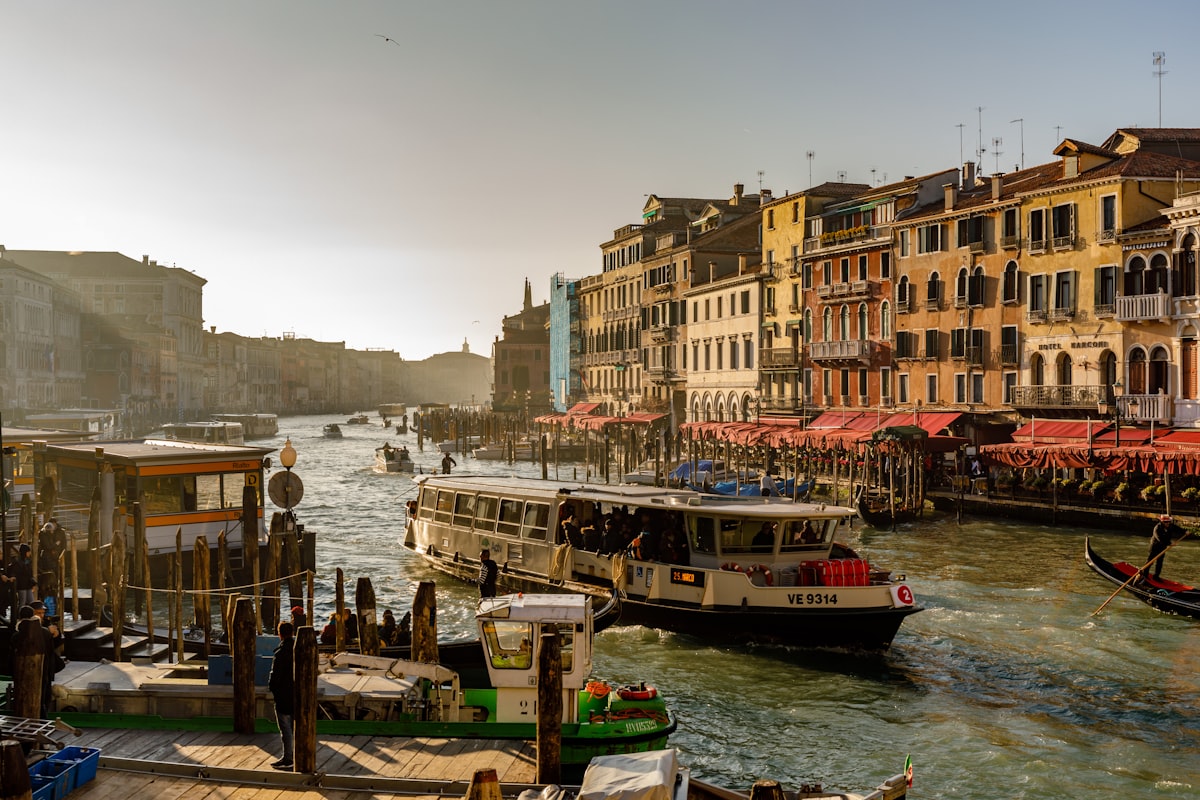
ACTV vaporetto on the Grand Canal. Photo by Henri Picot on Unsplash
Venice is the simplest Italian city to get around because driving is impossible. Cars stop at Piazzale Roma or Tronchetto at the western edge. Everything past that is reachable by boat or on foot. Venezia Santa Lucia is the train station on the historic island.
Vaporetti are the metro. ACTV runs ~19 vaporetto lines. Tourist routes: Line 1 (scenic Grand Canal, every stop, 45 minutes), Line 2 (express, 25 minutes), Line 4.1/4.2 (Murano loop). Single ride €9.50, valid 75 minutes.
Venice Vaporetto Pass Pricing
Pass | Cost | Duration | Break-Even |
|---|---|---|---|
Single ride | €9.50 | 75 minutes | Single ride only |
24-hour pass | €25 | 24 hours | 3 rides |
48-hour pass | €35 | 48 hours | 4 rides over 2 days |
72-hour pass | €45 | 72 hours | 5 rides over 3 days |
7-day pass | €65 | 7 days | 7 rides total |
Venice vaporetto pass prices set by ACTV, verified January 2026. The Rolling Venice card (€6, ages 6-29) cuts these prices by roughly 30%.
Walking wins for short hops. Venezia Santa Lucia to San Marco is a 30-40 minute walk through some of the best alleys in Venice. Vaporetto Line 1 takes 25-40 minutes with stops. Walk by day, vaporetto with luggage or at night.
Skip gondolas as transit. A gondola ride costs €80-90 for 30 minutes (€100-120 after 7 PM), capped by ordinance. Romantic experience, not transport. The traghetto, a standing gondola ferry across the Grand Canal at six crossings, costs €2.
Cinque Terre: Train Hops, No Cars
Regional train hugging the Cinque Terre coastline between villages. Photo by Juan Smith on Unsplash
Cinque Terre is a five-village stretch of cliff-side coast in Liguria built around the regional train line connecting the villages. Cars are blocked from most villages. The local train hops between villages in 2-5 minutes, and the Cinque Terre Card includes unlimited rides.
Villages north to south: Monterosso, Vernazza, Corniglia, Manarola, Riomaggiore. La Spezia is the train hub at the south end; Levanto sits just north of Monterosso.
Cinque Terre Card
Card Type | Cost | Includes |
|---|---|---|
Cinque Terre Trekking Card (1 day) | €7.50 | Hiking trails only, no train |
Cinque Terre Treno Card (1 day) | €18.20 | Unlimited regional train La Spezia-Levanto, hiking trails, ATC bus, Wi-Fi at stations |
Cinque Terre Treno Card (2 days) | €33 | 2-day version |
Cinque Terre card prices set by Parco Nazionale delle Cinque Terre, verified January 2026. Single regional train ride between villages is €5; the day card pays off at 4+ rides.
Hiking. The Sentiero Azzurro (Blue Trail) is partially closed due to landslides, but Manarola-Corniglia and Monterosso-Vernazza segments are usually open. Combine 1-2 hikes with train rides. Typical day: train La Spezia to Riomaggiore, train to Manarola, train to Vernazza, hike to Monterosso, train back.
Routing Italy across 4+ cities? Our AI trip planner builds the Trenitalia-vs-Italo, regional-vs-high-speed, and rental-vs-train calls into a single itinerary so you do not spend evenings cross-shopping two apps.
Sicily and Sardinia: Ferries, Flights, and In-Island Cars
Sicily and Sardinia both follow the same logic: get there by ferry or flight, then rent a car or use limited local transit once you arrive.
Getting to Sicily. Trenitalia loads train cars onto ferries at Villa San Giovanni, the only direct train route. Frecciarossa to Reggio Calabria plus ferry transfer is 5-6 hours from Rome. Overnight ferries from Naples or Civitavecchia (Grandi Navi Veloci, Tirrenia, GNV) run to Palermo and Catania, 10-13 hours, €40 deck or €80-150 cabin. Book via Ferryhopper or the operator. Flights to Catania (CTA) and Palermo (PMO) run €30-90 on Ryanair, ITA, or easyJet.
Getting to Sardinia. Tirrenia, Moby, and Grimaldi ferry from Civitavecchia, Genoa, Livorno, and Naples to Olbia, Cagliari, or Porto Torres, 7-13 hours mostly overnight, €35-120 by cabin tier. Flights to Cagliari (CAG), Olbia (OLB), and Alghero (AHO) run cheap on Ryanair and easyJet.
Once on island: rent a car. Both islands have limited transit outside major cities. Sicilian rail is slow (Palermo-Catania takes 3 hours for 200 km). Sardinia's is sparser. €35-60 per day rental from the airport is the practical choice.
Continuing to Greece? Our Greek Islands itinerary guide covers the Italy-to-Greece overnight ferry (Bari or Brindisi to Patras/Igoumenitsa).
When You Actually Want to Rent a Car in Italy
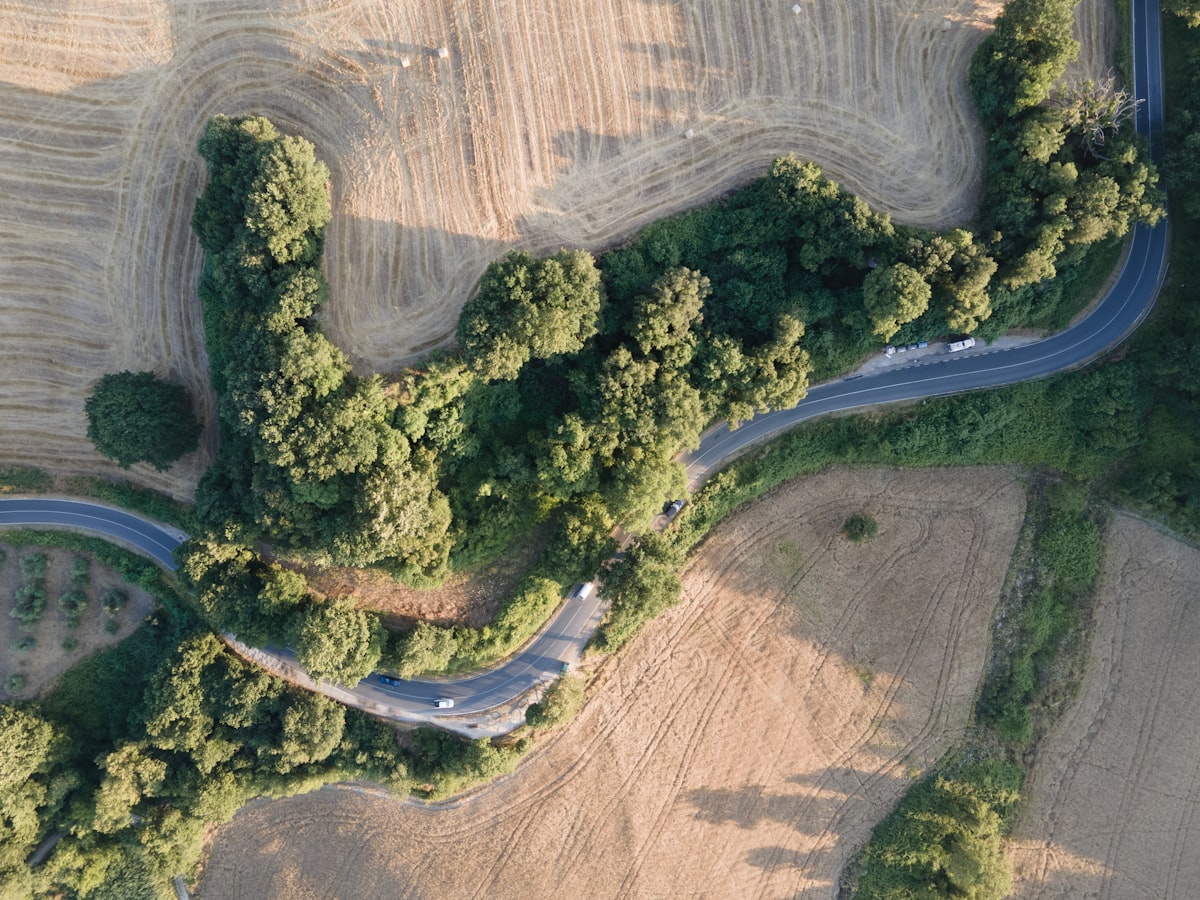
A winding back road in rural Tuscany. Photo by Jonathan Arbely on Unsplash
Good reasons to rent a car in Italy exist. They are mostly not in the cities.
Rent for Tuscan or Umbrian road trips (wineries, hill towns, agriturismos); for Puglia (Lecce, Alberobello, Matera, Polignano a Mare, Ostuni), where public transit is slow and patchy; for rural Sicily (Mount Etna, Modica, Ragusa, Cefalù); for Sardinia's beaches; or for the Dolomites where you want multiple mountain passes. Do not rent for Rome-Florence-Venice (take the train), do not rent if you are spending more than two days inside any city center, and do not rent if your trip stays north (Milan, Como, Bergamo, Verona, Venice is all rail).
Italy Car Rental Pricing
Vehicle Class | Daily Rate (Shoulder Season) | Daily Rate (Peak Summer) | Notes |
|---|---|---|---|
Economy (Fiat Panda, Renault Clio) | €35-50 | €55-90 | Local agencies often cheapest |
Compact (VW Polo, Ford Fiesta) | €40-65 | €65-110 | International chains for reliability |
Mid-size (VW Golf, Ford Focus) | €55-85 | €85-130 | Family-trip standard |
SUV / 4WD | €80-120 | €130-200 | Required for some Sardinia interior roads |
Manual transmission | Saves 15-25% vs automatic | Same | Worth learning if you drive stick |
Italy car rental price sources: AutoEurope, Discover Cars, and direct quotes from Hertz, Avis, Sixt, and Europcar. Rates exclude insurance and fuel. Peak summer covers mid-June through August.
Insurance reality: Italian rentals quote a base rate excluding the legally required CDW (Collision Damage Waiver). Your premium credit card may cover it (verify before traveling), but at the counter, agents pressure-sell zero-excess insurance for €15-25 per day. The unbundling is coming.
ZTL rule, repeated: cameras enforce automatically. By the time the rental company forwards the fine weeks later (with a €40-60 handling fee), it is too late to dispute.
Italy Train Pass: Eurail Italy and Trenitalia Pass, Worth It?
Usually not, for tourists doing the classic Rome, Florence, Venice loop. Sometimes worth it for multi-week explorers hitting 5+ cities.
Trenitalia and Italo run aggressive advance-purchase pricing that often beats the per-day pass when you book 2-4 weeks ahead.
Italy Train Pass Comparison
Pass | Cost | Duration | Includes | Break-Even |
|---|---|---|---|---|
Eurail Italy Pass (3 days in 1 month) | $189 (~€175) | 3 travel days | All Trenitalia trains; €13 reservation fee per HSR train | 3+ long-haul HSR trips |
Eurail Italy Pass (5 days in 1 month) | $239 (~€220) | 5 travel days | Same | 5+ HSR trips |
Eurail Italy Pass (8 days in 1 month) | $309 (~€285) | 8 travel days | Same | 8+ HSR trips |
Trenitalia Pass (3 days in 7) | €129 | 3 days within 7 | Trenitalia trains; reservation fees apply | 3+ HSR trips in a week |
Italo Smart Plan | Variable | Pre-paid multi-trip pack | Italo trains, no reservation fees | Frequent Italo riders |
Italy train pass prices from Eurail and Trenitalia, verified January 2026. USD conversions at approximately $1.09 per euro.
When it pays off. A classic Rome, Florence, Venice, Milan, Rome loop with 4 high-speed legs averages €40-60 per leg at 14 days out, totaling €160-240. Eurail Italy 5-day at $239 (~€220) plus €13 x 4 reservation fees (€52) comes to €272. Individual tickets win.
The pass makes sense for 6+ long-haul trips, last-minute purchases (rack-rate €70-100 per leg), or when you value mid-trip flexibility. For most planned 7-14 day trips, individual tickets via the apps win.
Ready to Plan Your Italy Trip?
Routing Italy across multiple cities, choosing Frecciarossa or Italo, knowing when to ferry to Sicily, knowing when to grab a rental for Tuscany versus stay on rails: this is the kind of planning that eats up evenings. Zenvoya's AI trip planner builds a complete Italy itinerary with optimized routing, station-to-station transit picks, and ZTL-aware hotel choices, so you know which mode to use for each leg before you leave.
For more context, see our Japan transportation guide and best summer vacation destinations.
Conclusion
Italy is built for train travel. The high-speed network covers the spine, regional trains fill the gaps, and the biggest cities are walkable in ways that make rental cars a liability. Save the rental for Tuscany back roads, Puglia, the Dolomites, or the islands. Book high-speed at least two weeks out via the Trenitalia or Italo apps. Validate regional tickets before boarding. Skip the rail pass unless your itinerary is wildly ambitious.
Get those choices right and Italy becomes one of the easiest places in Europe to explore.