Compare trains, flights, and buses in Japan with 2026 pricing. Route-by-route breakdowns for shinkansen, highway buses, domestic flights, and the JR Pass.
Japan transportation comes down to four main options: bullet trains (shinkansen) for fast intercity travel, domestic flights for long distances like Tokyo to Sapporo, highway buses for budget routes, and IC cards for local city transit. The right choice depends on your route, budget, and schedule. Here's how each mode compares in 2026.
Japan's transportation system is famously efficient, but figuring out which option to use for each leg of your trip can get tricky. This guide breaks down every major way of getting around Japan, with real 2026 pricing, route-by-route comparisons, and honest opinions on what's actually worth your money. If you're stitching together a multi-city Japan trip, our how to plan an international trip framework covers the end-to-end steps, and Zenvoya's AI trip planner can build the actual day-by-day route in minutes.
Japan Transport at a Glance
Fastest option: Shinkansen (bullet train) for most intercity routes. Tokyo to Osaka in 2 hours 15 minutes, covering 515 km.
Cheapest option: Highway buses, often 60-75% less than trains on the same route. Tokyo to Osaka from 3,500 yen ($23).
Best value for multi-city trips: The Japan Rail Pass at 50,000 yen ($333) for 7 days, if you're covering 3+ cities.
When to fly: Anything involving Hokkaido or Okinawa. Budget carriers like Peach Aviation offer fares from 7,000 yen ($47).
City transit: Get a Suica or PASMO IC card on day one. Tap and go on trains, buses, and at 1.1 million retail locations nationwide.
Japan's Transportation System at a Glance
Japan operates the world's most punctual intercity rail network, with an average Tokaido Shinkansen delay of under 1 minute per trip, according to the Central Japan Railway Company (JR Central). The backbone is rail, operated primarily by Japan Railways (JR Group) across six regional companies, running shinkansen bullet trains plus a network covering 20,000+ km of track. Private railways, city subways, and bus systems fill in the gaps, creating a combined network of over 27,000 km of rail.
No single transport mode wins every time. Tokyo to Osaka? Train, every time. Tokyo to Sapporo? Fly. Tokyo to Nagoya on a backpacker budget? The bus saves you serious cash.
Japan Transportation: Complete Mode Comparison (2026 Pricing)
Mode | Best For | Typical Cost Range (2026) | Speed | Network Coverage |
|---|---|---|---|---|
Shinkansen (bullet train) | Intercity travel on Honshu, northern Kyushu | 8,000-23,000 yen ($53-$153) per trip | 200-320 km/h | 3,041 km across 9 lines |
Local/regional trains | City-to-suburb, short intercity hops | 150-3,000 yen ($1-$20) | 60-130 km/h | 20,000+ km JR + private lines |
Domestic flights | Hokkaido, Okinawa, Kyushu from Tokyo | 5,000-25,000 yen ($33-$167) | Fastest for 600+ km routes | 80+ domestic airports |
Highway buses | Budget intercity travel, overnight savings | 2,000-10,000 yen ($13-$67) | 60-80 km/h avg, but cheapest | All major city pairs |
City subway/metro | Within Tokyo, Osaka, Kyoto, Hiroshima | 170-400 yen ($1.10-$2.70) per ride | Trains every 2-5 min in Tokyo | 13 subway lines in Tokyo alone |
Sources: JR Group published fares, Japanese Ministry of Land, Infrastructure, Transport and Tourism (MLIT) annual rail statistics. USD conversions at approximately 150 yen/$1 as of early 2026.
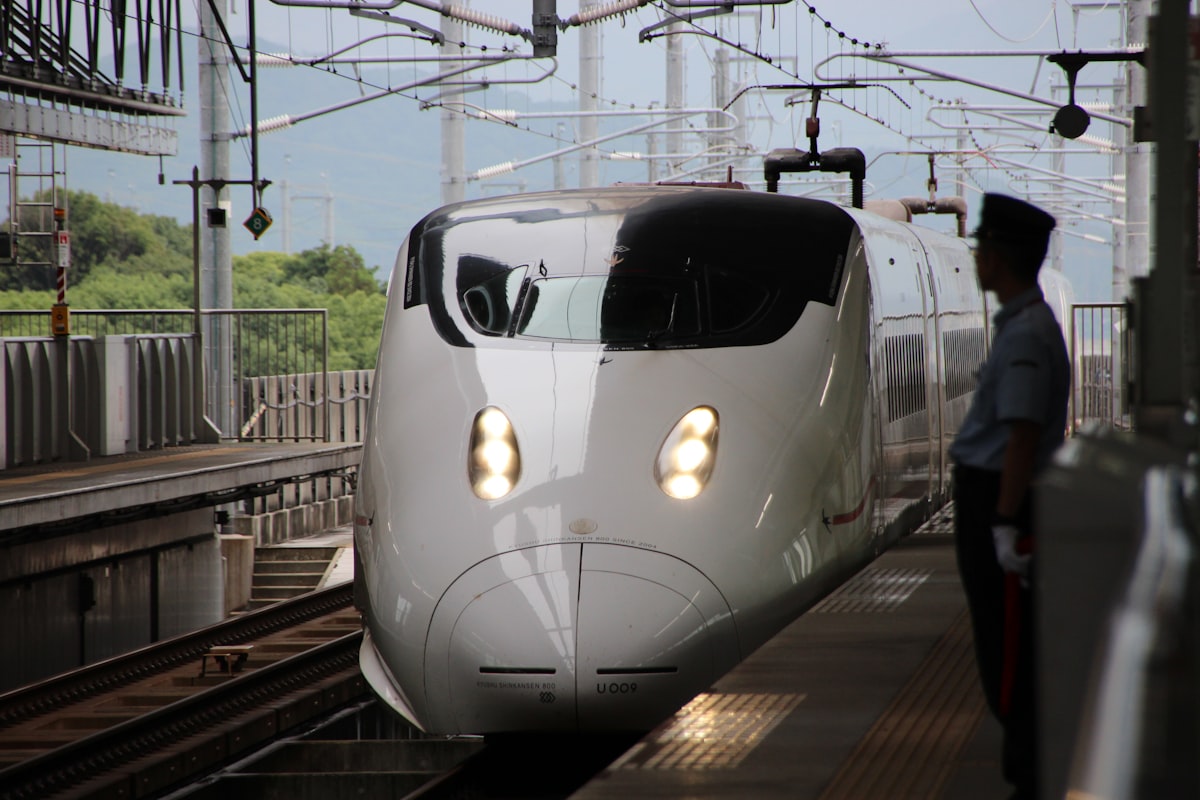
Shinkansen at a Kyushu station platform. Photo by Rikku Sama on Unsplash
Shinkansen: The Backbone of Japan Travel
The shinkansen bullet train is the fastest, most reliable intercity ground transport in Japan, connecting Tokyo to Osaka (515 km) in just 2 hours 15 minutes with zero transfers. The Tokaido Shinkansen alone runs roughly 370 trains per day across three service tiers (Nozomi, Hikari, Kodama), according to JR Central's 2025 timetable data. No check-in process, no security screening, and stations are right in the city center.
Pre-booking shinkansen seats through the SmartEX app saves travelers about 12 minutes per trip compared to queuing at ticket machines. Over a 7-day trip hitting 4 cities, that adds up to nearly an hour reclaimed.
Shinkansen Routes and 2026 Pricing
Route | Line | Distance | Time | Reserved Seat (2026) | Unreserved Seat |
|---|---|---|---|---|---|
Tokyo to Osaka | Tokaido (Nozomi) | 515 km | 2h 15min | 14,720 yen (~$98) | 13,870 yen (~$92) |
Tokyo to Kyoto | Tokaido (Nozomi) | 476 km | 2h 8min | 14,170 yen (~$94) | 13,320 yen (~$89) |
Tokyo to Hiroshima | Tokaido-Sanyo (Nozomi) | 894 km | 3h 50min | 19,760 yen (~$132) | 18,910 yen (~$126) |
Tokyo to Kanazawa | Hokuriku | 450 km | 2h 30min | 14,580 yen (~$97) | 14,080 yen (~$94) |
Tokyo to Sendai | Tohoku (Hayabusa) | 352 km | 1h 30min | 11,410 yen (~$76) | All reserved |
Osaka to Hiroshima | Sanyo (Nozomi) | 342 km | 1h 25min | 10,640 yen (~$71) | 10,090 yen (~$67) |
Tokyo to Nagoya | Tokaido (Nozomi) | 366 km | 1h 40min | 11,300 yen (~$75) | 10,560 yen (~$70) |
Prices based on JR Group published fares as of early 2026. USD conversions at approximately 150 yen/$1.
Tips for Riding the Shinkansen
Reserved vs. unreserved seats: Unreserved cars exist on Hikari and Kodama trains. During peak periods (Golden Week from April 29 to May 5, Obon from August 13-16, and New Year from December 28 to January 3), reserve in advance. The Hayabusa (Tohoku line) is all-reserved.
Luggage: Suitcases over 160 cm total dimensions require a reserved seat with a baggage area behind the last row. Free but mandatory since May 2020. Book through the SmartEX app.
Food on board: Grab an ekiben (station bento box) before boarding. Tokyo Station's "Ekiben-ya Matsuri" shop stocks over 200 varieties. Prices run 800-1,500 yen ($5-$10).
Local Trains and Subways in Japanese Cities
City transit runs on a separate system from the shinkansen. Tokyo alone has 13 subway lines operated by Tokyo Metro and Toei, plus the essential JR Yamanote loop (3.5 million passengers daily) and several private railways. It all works with a single IC card. Once you are based in the city, our guide to things to do in Tokyo maps the highlights by neighborhood.
Key networks: Tokyo has the most complex system (JR Yamanote Line, 9 Metro lines, 4 Toei lines). Osaka Metro covers 9 lines and 133 stations. Kyoto relies heavily on buses (700 yen/day pass covers most temple routes). Hiroshima's streetcar system is simple at 220 yen ($1.50) flat fare.
Day passes worth knowing: Tokyo Subway 24-Hour Ticket (800 yen, breaks even at 4 rides), Osaka Amazing Pass (2,800 yen, includes 50+ attraction entries), and Kyoto Bus One-Day Pass (700 yen). Sources: Tokyo Metro, Osaka Convention & Tourism Bureau, Kyoto City Transportation Bureau. Prices verified as of January 2026.
When to Fly Instead of Take the Train
Domestic flights are underrated by foreign visitors, yet Japan's domestic aviation market carried 97.6 million passengers in fiscal year 2024, according to the MLIT. For routes exceeding 600 km, flying is frequently faster, cheaper, or both.
The rule of thumb: if the shinkansen takes more than 4 hours, check flight prices. Peach Aviation (35+ domestic routes from Kansai), Jetstar Japan, and ANA's "Super Value" fares regularly offer routes under 10,000 yen ($67) when booked 28+ days in advance.
Best Routes for Flying vs Train (2026)
Route | Distance | Flight Time | Flight Cost (2026) | Train Time | Train Cost | Verdict |
|---|---|---|---|---|---|---|
Tokyo to Sapporo | 831 km | 1h 35min | 7,000-20,000 yen | 8h+ | 27,000+ yen | Fly. Saves 6+ hours. |
Tokyo to Okinawa | 1,554 km | 2h 45min | 8,000-25,000 yen | No train | N/A | Fly (only option). |
Tokyo to Fukuoka | 1,069 km | 2h | 7,000-18,000 yen | 5h (Nozomi) | 23,390 yen | Fly if budget; train if convenience. |
Osaka to Sapporo | 1,059 km | 2h 5min | 8,000-22,000 yen | 10h+ | 28,000+ yen | Fly. No viable train alternative. |
Tokyo to Kagoshima | 1,325 km | 2h | 8,000-20,000 yen | 6h 30min | 28,000+ yen | Fly saves both time and money. |
Flight costs reflect advance booking (2-4 weeks out) on budget and full-service carriers as of 2026.
The hidden cost of flying: Factor in 60-90 minutes for airport transit (Narita Express at 53 min, 3,070 yen; Haneda Monorail at 20 min, 500 yen) plus arriving 60 minutes early. That 1.5-hour Sapporo flight becomes 4 hours door-to-door. Still faster than the 8-hour train, but the gap narrows on shorter routes.
Highway Buses: The Budget Traveler's Secret
Highway buses are the cheapest intercity transport in Japan, with fares running 60-75% less than shinkansen tickets. The sweet spot is overnight routes: board around 10-11 PM, arrive by 6-7 AM, saving a hotel night AND transit cost. Over a 2-3 week trip, that can free up 30,000-50,000 yen ($200-$333).
Highway Bus Pricing vs Shinkansen (2026)
Route | Bus Time | Bus Cost (2026) | Shinkansen Cost | You Save | Savings % |
|---|---|---|---|---|---|
Tokyo to Osaka | 7-9h (overnight) | 3,500-8,500 yen ($23-$57) | 13,870-14,720 yen | 5,370-11,220 yen | 42-75% |
Tokyo to Kyoto | 7-8h (overnight) | 3,200-8,000 yen ($21-$53) | 13,320-14,170 yen | 5,320-10,970 yen | 44-76% |
Tokyo to Nagoya | 5-6h | 2,400-5,500 yen ($16-$37) | 10,560-11,300 yen | 5,060-8,900 yen | 51-77% |
Osaka to Hiroshima | 5-6h | 3,000-6,000 yen ($20-$40) | 10,090-10,640 yen | 4,090-7,640 yen | 44-70% |
Tokyo to Sendai | 5-6h | 2,500-6,000 yen ($17-$40) | 11,410 yen | 5,410-8,910 yen | 47-78% |
All bus prices reflect 2026 advance booking rates. Japan's MLIT regulates bus safety standards with mandatory driver rotation for routes over 400 km.
Comfort tiers: Standard 4-row seats work for short daytime trips. For overnight routes, upgrade to 3-row independent seats (5,000-8,000 yen) with 140-degree recline and privacy curtains. Premium nearly-flat seats run 8,000-12,000 yen, approaching shinkansen pricing. Book through Willer Express (willerexpress.com) or Japan Bus Online (japanbuslines.com) 2-4 weeks ahead for the best rates.
Train vs Flight vs Bus on Popular Routes
This is the comparison that matters for planning Japan transportation in 2026.
Bullet train ready for departure. Photo by Darien Attridge on Unsplash
Tokyo to Osaka
Factor | Shinkansen | Flight | Highway Bus |
|---|---|---|---|
Travel time | 2h 15min | 1h 15min (air only) | 7-9h |
Door-to-door time | ~2h 45min | ~4h (with airport transit) | 7-9h |
Cost (one-way, 2026) | 13,870-14,720 yen ($92-$98) | 7,000-15,000 yen ($47-$100) | 3,500-8,500 yen ($23-$57) |
Departures per day | 370+ (all tiers) | 30+ | 50+ |
Our pick | Shinkansen. City center to city center in 2h 15min, no contest. | Fly only if you find a sub-8,000 yen fare. | Great overnight to save a hotel night. |
Tokyo to Sapporo (Hokkaido)
Factor | Shinkansen | Flight | Highway Bus |
|---|---|---|---|
Travel time | 7h 40min (Hayabusa + transfer) | 1h 35min | No direct service |
Door-to-door time | ~9h | ~4h 30min | N/A |
Cost (one-way, 2026) | 27,000+ yen ($180+) | 7,000-20,000 yen ($47-$133) | N/A |
Our pick | Fly. Faster by 4.5 hours and almost always cheaper. | Winner | N/A |
Tokyo to Hiroshima
Factor | Shinkansen | Flight | Highway Bus |
|---|---|---|---|
Travel time | 3h 50min | 1h 25min | 11-12h |
Door-to-door time | ~4h 15min | ~4h 30min | 11-12h |
Cost (one-way, 2026) | 18,910-19,760 yen ($126-$132) | 8,000-18,000 yen ($53-$120) | 5,000-10,000 yen ($33-$67) |
Our pick | Shinkansen if you have a JR Pass; door-to-door times are nearly identical to flying. | Fly if no pass and booking 3+ weeks early. | Overnight bus saves money, but 11 hours is long. |
Is the Japan Rail Pass Worth It in 2026?
For most travelers, only on the classic 3+ city loop. The Japan Rail Pass (JR Pass) costs 50,000 yen ($333) for 7 days of unlimited travel on most JR trains, including shinkansen, but it no longer pays for itself on simple roundtrip routes after the October 2023 price increase of roughly 70%. It pays off when you string together 3+ major shinkansen trips covering 1,200+ km, like the Tokyo-Kyoto-Hiroshima-Osaka loop.
When the JR Pass Pays for Itself
Itinerary Example (7-Day Pass, 50,000 yen) | Individual Ticket Cost | Savings | Verdict |
|---|---|---|---|
Tokyo > Kyoto > Hiroshima > Osaka > Tokyo | ~57,000 yen ($380) | 7,000 yen saved ($47) | Worth it |
Tokyo > Osaka > Kanazawa > Tokyo | ~52,000 yen ($347) | 2,000 yen saved ($13) | Marginal |
Tokyo > Sendai > Tokyo (weekend trip) | ~22,000 yen ($147) | Lost 28,000 yen ($187) | Not worth it |
Tokyo > Kyoto > Tokyo (only route) | ~28,000 yen ($187) | Lost 22,000 yen ($147) | Not worth it |
The honest take: The 7-day pass breaks even at 3+ major shinkansen trips covering 1,200+ km. A Tokyo-Kyoto roundtrip (952 km) does NOT justify it. The pass shines on the classic Tokyo-Kyoto-Hiroshima-Osaka loop.
Important caveat: The JR Pass does NOT cover Nozomi or Mizuho trains (the fastest on the Tokaido/Sanyo line). You'll ride the Hikari, adding about 20-30 minutes to Tokyo-Osaka. The 14-day (80,000 yen) and 21-day (100,000 yen) passes offer better per-day value. Regional passes like the JR Kansai Area Pass (7,000 yen/4 days) or JR Hokkaido Pass (20,000 yen/5 days) are often smarter for focused trips. Source: japanrailpass.net, prices as of 2026.
How to Pay: IC Cards, Cash, and Apps
IC cards (Suica, PASMO, ICOCA) are rechargeable contactless transit cards accepted on virtually all trains, buses, and at 1.1 million retail locations. All three work interchangeably nationwide through Japan's IC card interoperability agreement (since 2013). The easiest setup in 2026: add a Mobile Suica to your iPhone (Apple Wallet, iOS 16+) or Android (Google Wallet) in about 3 minutes. Physical cards have been limited since the 2023 FeliCa chip shortage.
Cash still matters. The Japan Consumer Credit Association reported cashless payments at roughly 40% in 2025, so 60% of transactions still involve cash. Smaller restaurants, some buses, and temple fees (300-600 yen) require it. Use 7-Eleven or Japan Post ATMs for foreign card withdrawals. Carry 10,000-20,000 yen ($67-$133).
Essential apps: Hyperdia for route planning with real-time schedules, SmartEX for booking shinkansen tickets online (supports up to 30% early booking discounts), and Navitime for offline maps.
Ready to Plan Your Japan Route?
Figuring out which trains, flights, and buses to string together across a multi-city Japan trip is exactly the kind of planning headache that eats up hours. Zenvoya's AI trip planner can build a complete Japan itinerary with optimized routing, so you'll know exactly which transport option to use for each leg before you leave home.
For comparison points across other destinations, our how to get around Iceland guide walks through a very different transit landscape (no trains, lots of road trips), and the how to get around Italy guide shows what a rail-first European trip looks like in comparison.