
A realistic Japan trip budget with daily costs for flights, hotels, food, rail, and activities across shoestring, mid-range, and comfort travel styles.
By Tarun A.
The honest answer is that a trip to Japan costs anywhere from $1,500 to $7,000 per person, and that range is so wide it's almost useless. So let's make it useful. The number you actually spend depends on three things: how you fly, where you sleep, and how often you eat at a restaurant versus a convenience store. Nail those three and everything else is rounding error.
This guide breaks the cost of a trip to Japan into three realistic tiers, shoestring, mid-range, and comfort, with line-item daily costs for flights, hotels, food, transport, and activities. You'll get a total for a typical 7-10 day trip at each tier, plus the spots where people quietly overspend. It's written for first-timers planning a one-to-two week trip from the US, the kind of traveler who wants a real Japan travel budget, not a vague "it depends."
One thing working in your favor right now: the yen has been weak against the dollar for a while, which means your money stretches further in Japan than it did a decade ago. Restaurant meals, trains, and hotels all feel like a relative bargain. That's the backdrop for every number below.
Japan Trip Cost at a Glance
Shoestring: about $1,500-2,200 per person for 7-10 days (hostels, convenience-store meals, local trains, flights included)
Mid-range: about $2,800-4,000 per person (3-star hotels, mix of restaurants and casual spots, JR Pass or IC card)
Comfort: about $5,000-7,000+ per person (4-star hotels and a ryokan night, sit-down dinners, taxis and reserved trains)
Biggest single cost: round-trip flights from the US, typically $900-1,500 in economy
Daily on-the-ground spend (excl. flights): roughly $70 shoestring, $180 mid-range, $350+ comfort
What Drives the Cost of a Trip to Japan
Five buckets cover almost everything you'll spend: flights, accommodation, food, local transport, and activities. The split is lopsided. For a typical trip, flights and hotels eat up well over half your total, while food and trains, the parts everyone worries about, are surprisingly manageable.
Here's the rough share of a mid-range budget, before you start tweaking:
Cost bucket | Share of a mid-range trip | Why it lands here |
|---|---|---|
Flights (round-trip from US) | 30-40% | Your single biggest line item, set by season and how early you book |
Accommodation | 25-35% | Wide range; the gap between a hostel and a 4-star hotel is enormous |
Food | 12-18% | Easier to control than you'd think; ramen and conbini meals are cheap |
Local transport | 8-12% | The Shinkansen looks pricey but a pass or IC card keeps it reasonable |
Activities and entry fees | 6-10% | Many temples and shrines are free or a few dollars |
Approximate budget shares for a mid-range 7-10 day trip from the US; actual splits vary by travel style.
The takeaway: if you want to spend less, the two levers that move the needle are flights and hotels. Skipping a $12 museum to save money is noise. Flying in shoulder season and booking a smarter hotel rate is signal. More on both below.
Pro tip: The cheapest part of Japan is the food you'll remember most. A bowl of ramen at a counter shop runs about $7-10, and a convenience-store breakfast from Lawson or 7-Eleven is genuinely good and under $5.
Flights: Your Biggest Single Expense
Getting to Japan is where most of your budget goes, so this is the number to obsess over. Round-trip economy fares from the US to Tokyo (Narita or Haneda) or Osaka (Kansai) typically land between $900 and $1,500, depending on your departure city and how far ahead you book. West Coast departures (Los Angeles, San Francisco, Seattle) run cheaper and shorter than East Coast or Midwest routes.
Average fares to Asia shift with season and fuel costs; the Airlines Reporting Corporation, which processes ticket data for US travel agencies, tracks these trends across the industry. Two patterns hold almost every year. Cherry blossom season (late March to April) and the fall foliage weeks (November) are peak, with the highest fares. January, February, and early December are the cheapest windows to fly, often $200-400 less round-trip.
Travel tier | Flight class | Typical round-trip from US | Notes |
|---|---|---|---|
Shoestring | Economy, shoulder season | $800-1,100 | Book 2-4 months out, fly midweek, consider a layover |
Mid-range | Economy, flexible dates | $1,000-1,400 | Direct flights from major hubs, decent seat selection |
Comfort | Premium economy or business | $2,500-6,000+ | The single fastest way to blow past a comfort budget |
Round-trip economy fare ranges from the US mainland to Tokyo or Osaka; premium-cabin pricing varies widely by route and airline.
If you have flexible dates, premium cabins are one area where smarter booking pays off. Zenvoya surfaces lower pricing on premium flight cabins, so an upgrade to premium economy doesn't have to mean paying full sticker price. For most first-timers, though, economy in a shoulder month is the move.
Pro tip: Flying into Tokyo and out of Osaka (or vice versa) on an "open-jaw" ticket often costs about the same as a round-trip but saves you a backtrack across the country, which means one fewer Shinkansen leg to pay for.
Accommodation: Where the Tiers Really Split
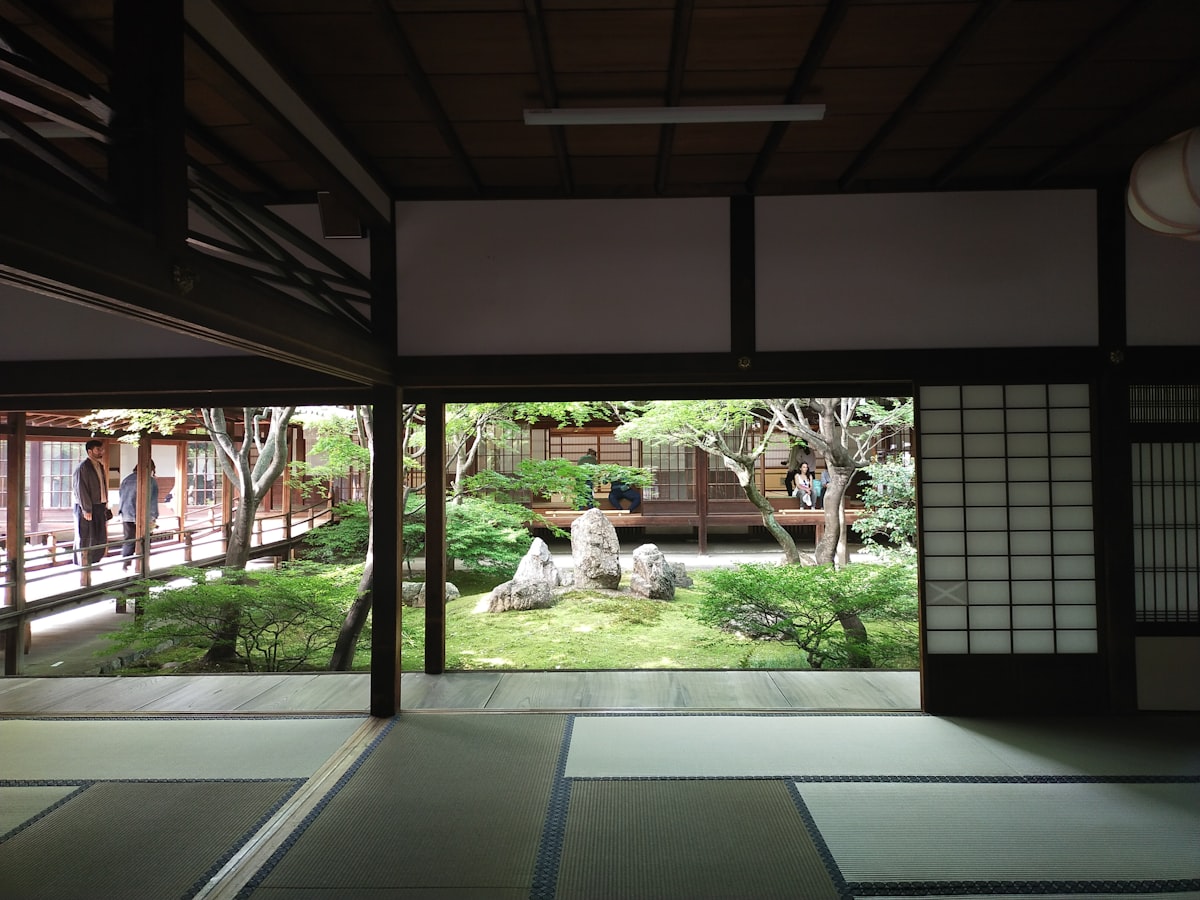
A ryokan room opens onto a quiet garden. Photo by Umanoide on Unsplash
Nowhere does your travel style show up in the numbers more than where you sleep. Japan's range is huge, from a $30 capsule pod to a $600 ryokan with a private hot spring. According to Booking.com 2026 average rates, mid-range hotel prices in Tokyo and Kyoto cluster around $120-180 per night for a clean, well-located 3-star room, while business-hotel chains like APA and Toyoko Inn often dip below $100.
A note on how Japanese hotels price: many quote per person, not per room, especially ryokan and traditional inns. Always check whether a rate is per night or per person before you book. Business hotels are the exception and almost always price per room.
Travel tier | Lodging type | Nightly cost | 9-night total (solo) |
|---|---|---|---|
Shoestring | Hostel dorm, capsule hotel | $30-55 | $270-495 |
Mid-range | Business hotel, 3-star, private room | $110-180 | $990-1,620 |
Comfort | 4-star hotel, one or two ryokan nights | $250-450 | $2,250-4,050 |
Per-night ranges based on Booking.com 2026 average rates for Tokyo, Kyoto, and Osaka; ryokan and traditional inns often price per person rather than per room.
Couples and families get a real break here, since splitting a private room nearly halves the per-person cost. If you're traveling with friends, a few mid-range rooms split across a group can land everyone in comfort-tier hotels at mid-range prices. This is also where booking smarter quietly saves you money: Zenvoya's hotel search is built to surface lower rates (up to 30% lower than other sites on eligible properties), so you get smarter value without hunting across a dozen tabs for it.
Worth a splurge at least once: a night in a ryokan, ideally in Hakone, Kyoto, or the Japanese Alps. Yes, it runs $200-400 per person, but a multi-course kaiseki dinner and a private onsen soak is the kind of memory the trip is actually about. Budget for one, not five.
Food: Cheaper and Better Than You Expect
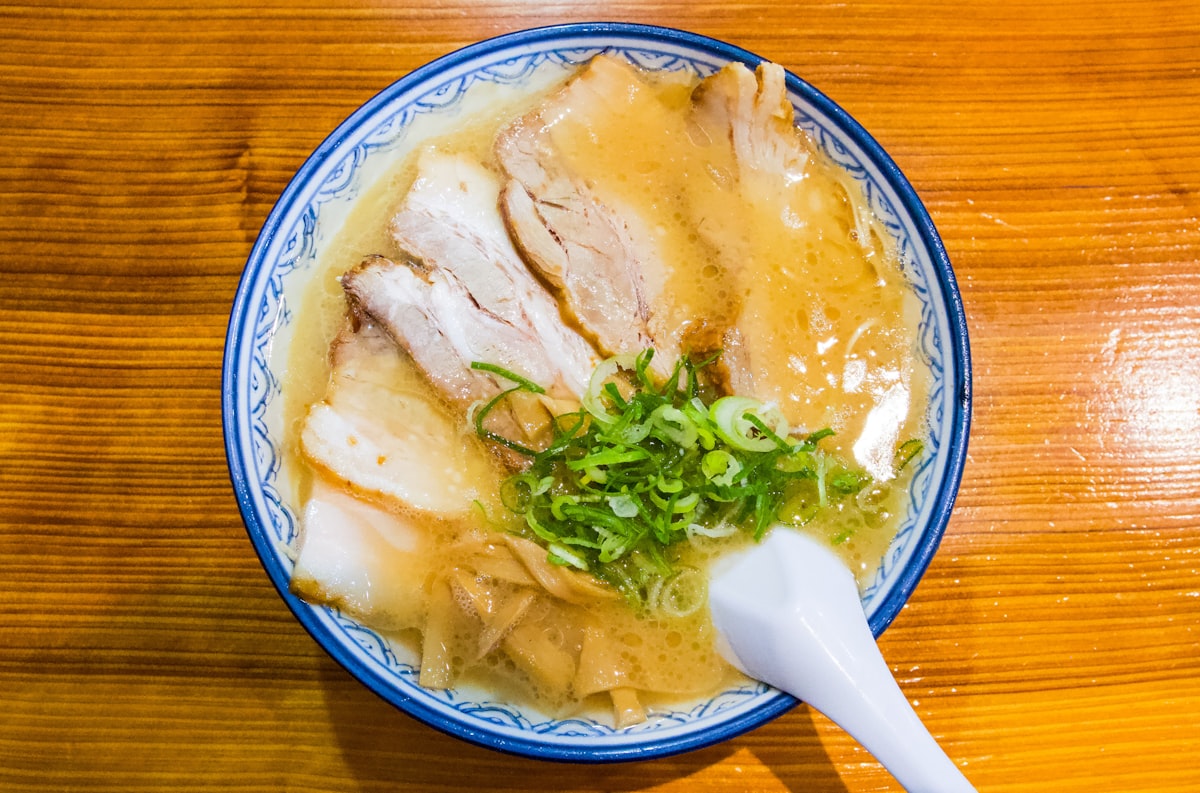
Tonkotsu ramen with extra pork, around $9. Photo by Frank from 5 AM Ramen on Unsplash
Here's the part that surprises everyone. Eating in Japan is delicious and, if you want it to be, cheap. A bowl of ramen, a plate of curry, or a set lunch (teishoku) at a neighborhood spot runs $7-12. Convenience stores, conbini in local shorthand, sell genuinely good onigiri, sandwiches, and bento for $3-6. You can eat extremely well on a shoestring budget without ever feeling deprived.
Where food costs climb is at the top end: a sushi omakase counter, a Kobe beef dinner, or a reservation-only kaiseki meal can run $80-200 per person. Those are events, not everyday meals. Most travelers mix a couple of splurge dinners into a week of cheap, fast, fantastic eating.
Travel tier | Daily food spend | What that looks like |
|---|---|---|
Shoestring | $25-40 | Conbini breakfast, ramen or curry lunch, casual dinner, vending-machine coffee |
Mid-range | $50-80 | Cafe breakfast, set lunch, izakaya or restaurant dinner, the occasional craft beer |
Comfort | $100-180 | Hotel breakfast, sit-down lunches, one omakase or Kobe beef dinner most nights |
Per-person daily food estimates spanning convenience-store meals through high-end dining; alcohol and premium dining push the comfort tier higher.
A few cheap-eat institutions worth knowing by name: Ichiran and Ippudo for ramen, CoCo Ichibanya for curry, Yoshinoya and Sukiya for gyudon beef bowls, and any department-store basement (depachika) in the evening, when prepared foods get marked down. Tap water is safe and free everywhere, so skip the bottled water habit.
Getting Around: The Shinkansen Question
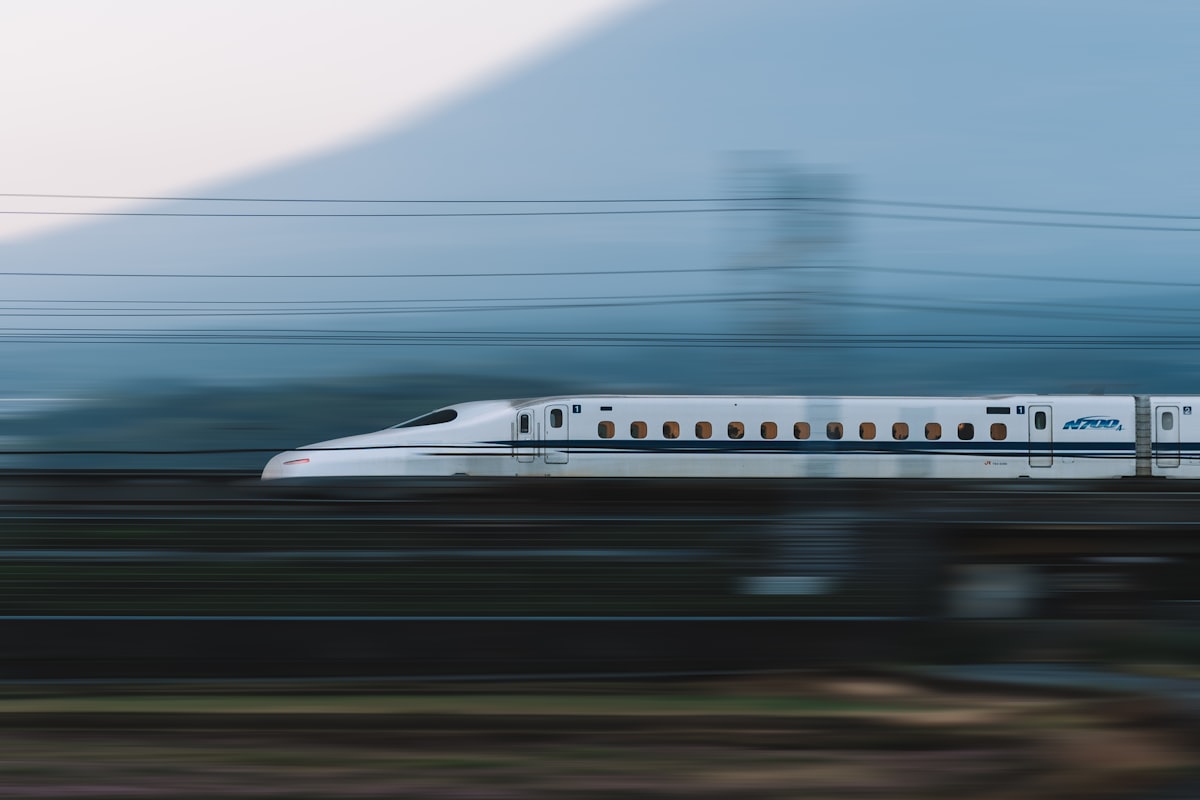
A bullet train races past Mount Fuji. Photo by Spenser Sembrat on Unsplash
Japan's trains are the thing first-timers fixate on, usually because of the Japan Rail Pass. The national Japan Rail Pass is a fixed-price ticket that covers most JR trains, including most bullet trains, for 7, 14, or 21 consecutive days. After a significant price increase, the 7-day nationwide pass now costs roughly $340-360 for an adult, per the official JR Pass site's 2026 pricing. That hike changed the math: the pass is no longer the automatic yes it once was.
The break-even is simple. The 7-day pass roughly equals one Tokyo-Kyoto round-trip plus a couple of shorter legs. If your itinerary is Tokyo, Kyoto, Osaka, and back, point-to-point Shinkansen tickets often cost about the same or less than the pass. If you're crossing the country, Tokyo to Hiroshima and beyond, the pass wins. We dig into the full break-even in our guide on whether the JR Pass is worth it.
Transport option | Typical cost | Best for |
|---|---|---|
7-day JR Pass (nationwide) | ~$340-360 | Long-distance, multi-region trips (Tokyo to Hiroshima and beyond) |
Single Shinkansen, Tokyo-Kyoto | ~$90 one way | Travelers staying in the Tokyo-Kyoto-Osaka corridor |
IC card (Suica, Pasmo, ICOCA) | Pay as you go | City subways, buses, local trains; about $5-12 per day |
Airport transfer (train) | $10-30 | Narita or Kansai into the city center |
Rail pricing per the official Japan Rail Pass site, 2026; single-fare and IC-card estimates reflect typical 2026 city and intercity travel.
For most one-week, three-city trips, an IC card for daily subway hops plus individual Shinkansen tickets for intercity legs beats the pass on cost. For the full mode-by-mode breakdown, our Japan transportation guide covers trains, subways, buses, and when a domestic flight makes sense.
Pro tip: Load a digital Suica or Pasmo card into Apple Wallet before you land. You tap through subway gates and pay at convenience stores with your phone, no fumbling for a physical card or coins.
Activities and Everything Else
Sightseeing in Japan is refreshingly affordable. Many of the country's most famous sights, the Meiji Shrine, Fushimi Inari's torii gates, the Imperial Palace gardens, cost nothing to enter. Temples and gardens that do charge usually run $3-7. The pricier experiences are the optional ones: teamLab digital art museums (around $25-30), a sumo tournament ticket ($40-150), a half-day guided tour ($60-120), or a theme park like Tokyo DisneySea or Universal Studios Japan ($60-90 per day).
Budget $15-25 a day for shoestring sightseeing, $30-50 mid-range, and $70+ if you're stacking paid experiences and tours. Don't forget the small stuff that adds up: coin lockers ($3-7), the occasional taxi ($8-20 around town), travel eSIM or pocket Wi-Fi ($5-8 per day), and souvenirs.
One newer line item to know about: Japan has been rolling out and raising tourism-related taxes and fees, including a departure tax and various local lodging taxes. The Japan National Tourism Organization is the authoritative source for current entry requirements and traveler fees. These are small individually (often a few dollars), but worth a line in your budget. One easy save: buy a prepaid travel eSIM before you fly instead of renting pocket Wi-Fi at the airport. It's cheaper, and your phone has data the second you land.
Total Cost by Tier for a 7-10 Day Trip
Put the line items together and here's what a typical one-week-plus trip actually costs per person, flights included. These totals assume 9 nights on the ground, a realistic length for a first Japan trip covering Tokyo, Kyoto, and Osaka.
Line item | Shoestring | Mid-range | Comfort |
|---|---|---|---|
Round-trip flight (US) | $900 | $1,200 | $3,000 |
Accommodation (9 nights) | $400 | $1,300 | $3,200 |
Food (10 days) | $330 | $650 | $1,400 |
Local transport + rail | $200 | $360 | $550 |
Activities and extras | $180 | $400 | $750 |
Per-person total | ~$2,010 | ~$3,910 | ~$8,900 |
Per-person estimates for a 9-night trip from the US covering Tokyo, Kyoto, and Osaka. Solo-traveler basis; couples and groups sharing rooms lower the per-person accommodation cost meaningfully. Reflects 2026 pricing.
A few honest caveats. Solo travelers pay the most per head because they shoulder a whole room alone; couples sharing a double can knock $400-700 off the per-person total. The comfort column climbs fast mostly because of premium flights and ryokan nights, pull those two back and a "comfort" trip lands closer to $5,000-6,000. And every number here scales with trip length: a 14-day trip adds roughly $700-1,500 per person over a 9-day one, depending on tier, since flights stay fixed while everything else grows.
So, is Japan expensive? Compared to Southeast Asia, yes. Compared to Western Europe or a comparable US trip, Japan is often cheaper than people expect, especially with the current exchange rate doing quiet work on every meal and train ticket.
How to Plan Your Japan Trip Budget
Start with the two big levers and let the rest follow. First, lock your flights early in a shoulder month (January, February, or early December for the lowest fares; avoid cherry blossom and fall foliage peaks if budget is tight). Our guide to the best time to visit Japan breaks down the cost-versus-crowds tradeoff month by month. Second, decide your accommodation tier honestly, since it's the second-biggest cost and the easiest to overspend on impulse.
Then sketch a route. A classic first-timer loop (Tokyo, Kyoto, Osaka, with a day trip or two) keeps transport costs down and avoids backtracking. Map it day by day and the daily-spend numbers above turn into a real total. You can build the whole thing, route, hotels, and day-by-day plan, in Zenvoya's AI trip planner in one conversation, and adjust the budget as you go. If you want a ready-made framework, our Japan travel itinerary lays out a route you can cost out tier by tier.
Ready to Plan Your Japan Trip?
You've got the numbers. The next step is turning them into a real trip: a route, hotels at your tier, and a day-by-day plan you can actually book. Tell Zenvoya's AI trip planner your dates, your budget, and who's coming, and it'll build the itinerary around you, then help you book flights and hotels in the same conversation. No thirty tabs, no second-guessing your spreadsheet.
Japan rewards a little planning. Pick your tier, fly in a shoulder month, eat the cheap ramen and splurge on one ryokan night, and you'll come home with a trip that felt richer than what it cost. That's the whole game.