
The best time to see the northern lights in Iceland is late September to March. Compare darkness, cloud and crowds by month, plus where to stay.
Late September through March is the best time to see the northern lights in Iceland, because that's when the nights get truly dark. Which month you pick matters less for the sky than you'd expect.
Quick answer: The best time to see the northern lights in Iceland is late September to late March. October and late February through March pair long nights with usable daylight near the equinoxes, which NOAA names as the best aurora seasons. December and January are the darkest and quietest, with 12-13 hours of full darkness at mid-month in Reykjavik. Cloud barely changes by month, so choose on darkness, daylight and crowds. Plan at least three nights away from city lights, ideally near a new moon.
Here's the surprise. Icelandic Met Office (IMO) records for 1991-2020 put average cloud over Reykjavik between 5.7 and 6.0 eighths of the sky in every month from September to April. There's no clear-sky month. What the month does change is how long your dark window lasts, how the roads behave, how busy the big sights are and what you'll do with your days. Those are the four things to weigh.
Zenvoya is an AI trip planner that also books and changes a trip in one conversation. Your flights, a Reykjavik hotel, a few countryside nights and a guided northern lights experience can all sit in one plan.
Which Month Is Best? September to April Compared
The best month to see the northern lights in Iceland depends on what you want from your days. Pick October for the best all-around balance, December or January for the most darkness and the fewest crowds, and late February or March for long days near the spring equinox. September works if you don't mind staying up late, and early April is a long shot.
Month | Full darkness, mid-month | Daylight, mid-month | Avg cloud (eighths of sky) | Roads and access | Crowds | What else you get | Choose it if |
|---|---|---|---|---|---|---|---|
September | 4h 45m | 13h 03m | 6.0/8 | Highland F-roads usually close mid-month; avg low 43°F | Busy | The fall equinox late in the month; mild nights | You want mild nights and long days |
October | 8h 50m | 9h 50m | 5.7/8 | F-roads closed until summer; avg low 37°F | Busy | The most even dark/light split; still close to the equinox | You want the best all-around balance |
November | 11h 35m | 6h 30m | 5.7/8 | Nights near freezing (avg low 32°F); check roads daily | Moderate | Glacier ice caves start opening | You want long nights with thinner crowds |
December | 12h 54m | 4h 13m | 5.8/8 | Below-freezing nights (avg low 29°F); short driving days | Quiet | Christmas; New Year's Eve bonfires and fireworks | You want maximum darkness and a holiday trip |
January | 12h 16m | 5h 25m | 6.0/8 | Below-freezing nights (avg low 29°F) | Quiet | Ice caves; some of the quietest sights of the year | You want long nights and few people |
February | 9h 56m | 8h 39m | 5.9/8 | Below-freezing nights (avg low 29°F); days lengthening fast | Moderate | Winter Lights Festival; ice caves | You want long nights plus real daylight |
March | 6h 44m | 11h 43m | 5.9/8 | Below-freezing nights (avg low 30°F) | Moderate | Spring equinox around Mar 20; ice caves usually still open | You want long days near the equinox |
April (fading) | 3h 47m on Apr 1; none after about Apr 9 | 15h 05m | 5.7/8 | Avg low 34°F; F-roads still closed | Moderate | Long spring days for sightseeing | You'll take the aurora if it shows up |
How this table was built: "Full darkness" is the time between the end and the start of astronomical twilight (the sun at least 18° below the horizon) on the 15th of each month in Reykjavik, from the U.S. Naval Observatory (USNO) 2026 twilight tables; Akureyri runs within about 45 minutes of these figures. Daylight is sunrise to sunset on the same date, from the USNO sunrise and sunset tables. Cloud cover (eighths of the sky, rounded) and average lows are 1991-2020 means calculated from the Icelandic Met Office's monthly data for the Reykjavík station. "Crowds" bands 2025 foreign departures through Keflavík Airport from the Icelandic Tourist Board: Busy is 200,000 or more, Moderate is 140,000-160,000 and Quiet is about 120,000. Equinox dates from the USNO; road notes from SafeTravel; ice cave timing from Visit Vatnajökull; festival from Reykjavík City (February 4-7 in 2027). Figures as of September 2026.
Three numbers from that table do most of the deciding. Mid-December's 12 hours 54 minutes of full darkness is about 2.7 times mid-September's 4 hours 45 minutes. Average cloud stays between 5.7 and 6.0 eighths of the sky all season, a gap of under 4% of the sky. And in the Icelandic Tourist Board's latest full-year count, Keflavík handled about 40% fewer foreign departures in December (120,000) than in October (201,000). Darkness and crowds change with the month. Cloud mostly doesn't.
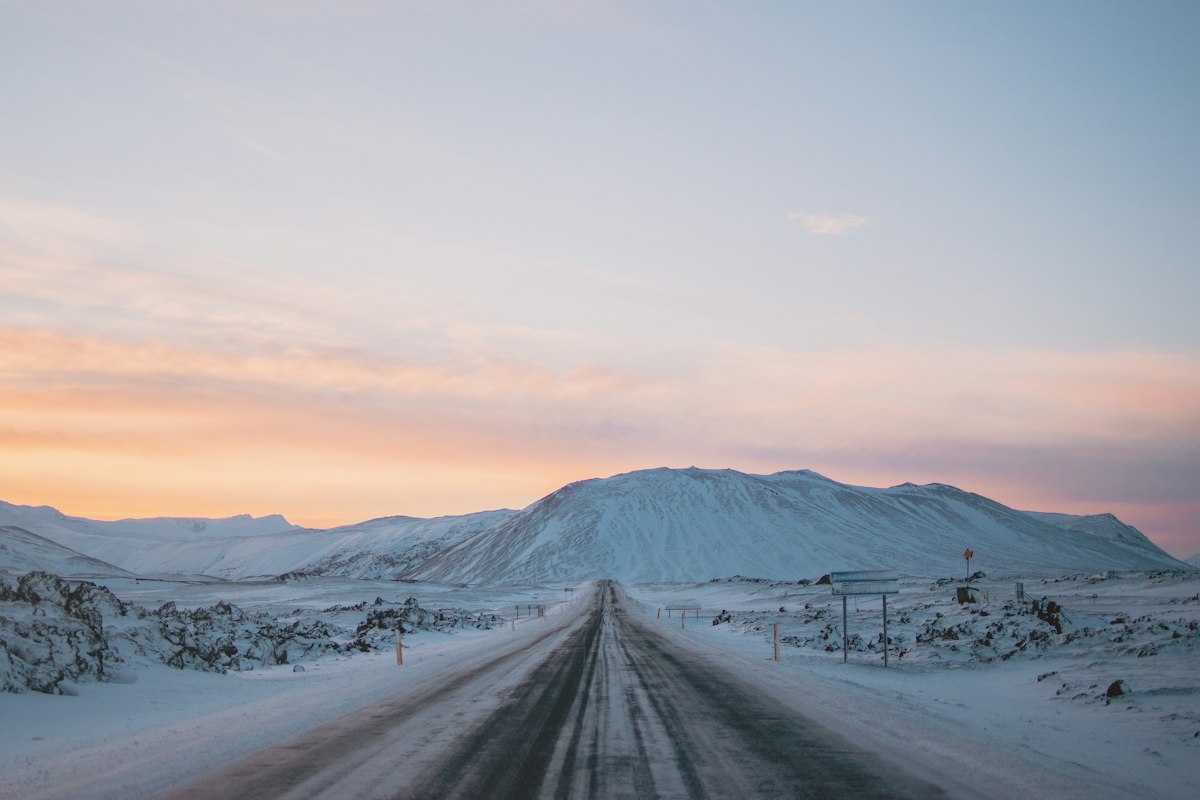
A snowy road on Snæfellsnes under a pink sky. Photo by Bailey Zindel on Unsplash
September: The Season Restarts
Full darkness returns to Reykjavik in the first days of September and reaches about four hours and 45 minutes by mid-month, per the U.S. Naval Observatory. It starts near 11 PM, so a September northern lights trip to Iceland means late nights. In return you get lows near 43°F, 13 hours of daylight and the last days before the highland F-roads close, which SafeTravel says usually happens mid-month. The fall equinox arrives late in the month, and NOAA's viewing guide notes a tendency toward larger geomagnetic storms near the equinoxes.
October: The Best All-Around Month
Mid-October gives you almost nine hours of full darkness and nearly ten hours of daylight, the most even split of the season. It's still busy: about 201,000 foreign visitors left through Keflavík in October in the Tourist Board's latest annual count, against 313,000 in peak August. October is our pick for a first northern lights trip to Iceland. Just check umferdin.is, the road-conditions map SafeTravel sends drivers to, before every drive.
November: Long Nights, Thinner Crowds
November is the hinge of Iceland's northern lights season. Darkness reaches about 11 and a half hours by mid-month, foreign departures fall to about 142,000 (Icelandic Tourist Board), and Visit Vatnajökull says the glacier ice caves become accessible from November, weather permitting. Daylight shrinks to about six and a half hours. If you'd happily trade daylight for darkness, November is where that trade starts paying off.
December: Maximum Dark, Minimum Day
Mid-December gives Reykjavik close to 13 hours of full darkness and a little over four hours of daylight. It's also the quietest month at Keflavík in the latest full calendar-year count, with about 120,000 foreign departures, and nationwide hotel occupancy that year bottomed out near 45%, per the Statistics Iceland figures in the Tourist Board's annual summary. Reykjavik lights neighborhood bonfires on New Year's Eve unless the wind tops 10 m/s (about 22 mph), and fireworks fill the sky around midnight. Chasing the northern lights in December? Check the moon dates below first.
January: The Quiet Month
January comes close to December for darkness, about 12 hours at mid-month, with roughly five and a half hours of daylight. It drew about 122,000 foreign departures in the latest full calendar-year count, with nationwide hotel occupancy around 46.5%, according to the same Tourist Board summary. The payoff for a northern lights trip in January: the big sights are about as quiet as they get all year.
February: Darkness and Daylight in Balance
Days lengthen fast now. By mid-February you have nearly ten hours of full darkness and about eight and a half hours of daylight. February also brings the capital area's Winter Lights Festival, when every event is free, including Museum Night and Pool Night. Ice caves are still in season. A February northern lights trip to Iceland suits families and anyone who wants a full day out before a late night.
March: The Equinox Month
The spring equinox falls around March 20, and mid-March brings almost 12 hours of daylight while full darkness drops under seven hours. That darkness starts around 10:15 PM, which still lines up with the 10 PM-2 AM window NOAA flags as the best time of night, and ice caves usually stay accessible through the month. With that much daylight, March northern lights trips pair well with a South Coast and Southeast route.
April: Fading Fast
Reykjavik gets under four hours of full darkness on April 1 and none after about April 9, per the USNO twilight tables. SafeTravel puts the end of the aurora season in late April, but by then you're watching through twilight. Treat early April as a nice extra on a spring trip, not the reason for one.
Where to See the Northern Lights in Iceland
You can see the northern lights anywhere in Iceland that's dark and away from city lights. The best-placed bases are the countryside around Hella, the South Coast around Vík, the Southeast near Jökulsárlón, Snæfellsnes and North Iceland around Mývatn, with Reykjavik as the easy option for short trips.
Cloud won't settle it: across the nine Icelandic Met Office stations below, October-March cloud averages land between 5.5 and 6.5 eighths of the sky, so pick a region for what it gives you by day. City glow you can control. Clouds you can only dodge.
Base | Sky glow | Avg cloud, Oct-Mar (eighths of sky) | Oct-Mar precipitation | Winter access | Best for |
|---|---|---|---|---|---|
City glow; darker at the edges of town | 5.8/8 | 20 in (520 mm) | About 31 miles (50 km) from Keflavík Airport, with airport buses into the city | First-timers, short trips, young kids | |
South Iceland countryside (Hella) | Rural and dark | 5.8/8 | 27 in (693 mm) | On Route 1 east of Reykjavik | One or two dark nights close to the city |
South Coast (Vík) | Rural and dark | 5.8/8 | 55 in (1,389 mm), the wettest here | Farther east along the same road | Waterfalls, black-sand beaches, photographers |
Southeast (Kirkjubæjarklaustur to Höfn) | Very dark | 5.5/8 (Kirkjubæjarklaustur), 5.7/8 (near Höfn) | 39 in (about 1,000 mm) | Long winter drive; some ice cave tours meet at Jökulsárlón | Ice caves plus aurora |
Snæfellsnes (Stykkishólmur) | Dark, small towns | 6.1/8 | 18 in (458 mm) | Northwest of Reykjavik | A quieter coast with mountain foregrounds |
North (Akureyri, Mývatn) | Town glow in Akureyri; very dark at Mývatn | 6.2/8 (Akureyri), 5.7/8 (Mývatn) | 15 in (375 mm) Akureyri; 10 in (251 mm) Mývatn, the driest here | Domestic flights from Reykjavik to Akureyri, or a long winter drive | Second trips; travelers fine with real cold |
Westfjords (Bolungarvík) | Very dark, remote | 6.5/8 | 22 in (565 mm) | Domestic flights from Reykjavik to Ísafjörður | Experienced winter travelers |
Cloud cover (eighths of the sky) and precipitation are 1991-2020 October-March averages calculated from Icelandic Met Office monthly station data for the station named in each row; "near Höfn" is Hólar í Hornafirði and Mývatn is Reykjahlíð. Some stations have fewer than 30 years of cloud records in that window, as few as 14 at Hella. Domestic routes per Reykjavík Airport's Icelandair listing; airport distance and buses per Keflavík Airport; Hella's position on Route 1 per Hotel Rangá's directions; ice cave meeting points per Iceland Travel Guide and Traveo listings. As of September 2026.
North Iceland often gets pitched as the clear-sky side, and the numbers only half back that up. Mývatn is the driest base on the list and among the least cloudy, but Akureyri averages more cloud than Reykjavik. Precipitation tells a sharper story: Vík gets more than five times Mývatn's winter precipitation, so the South Coast trades scenery for more wet nights.
Our take: base most first trips in Reykjavik plus one countryside region chosen for your days. Ice caves point you southeast, waterfalls and black-sand beaches to the South Coast, and a short trip to the countryside around Hella. For the city half, our guide to where to stay in Reykjavik breaks down the neighborhoods.
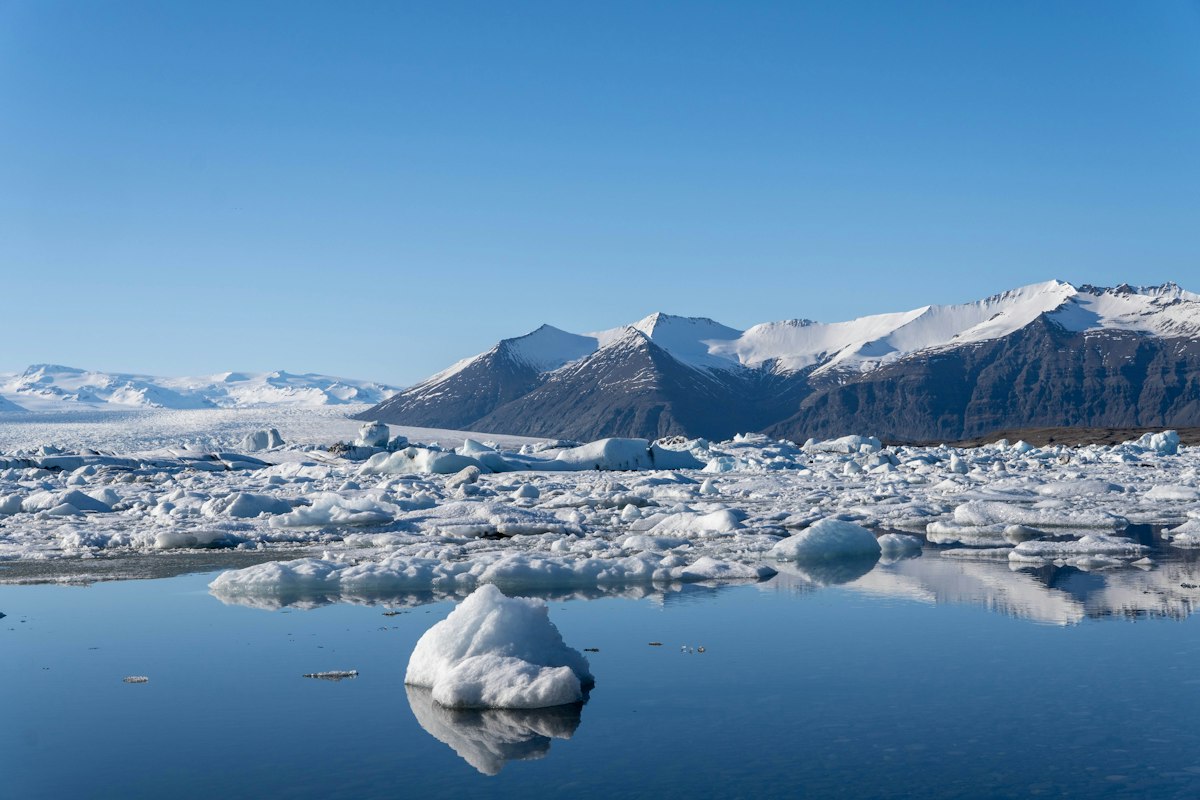
Icebergs drift on Jökulsárlón under snow-capped peaks. Photo by Juliann Hervio on Unsplash
How Many Nights Do You Need?
For an aurora trip to Iceland, plan at least three nights away from city lights, and four or five if the lights are the main reason you're going. Nobody can give you an honest percentage for your chances of seeing the northern lights in Iceland on a given trip, so here's the reasoning instead. Cloud averages around six-eighths of the sky all winter, so plenty of nights are socked in wherever you stay. SafeTravel warns that the weather can change at short notice, and NOAA's short-term aurora model only looks 30-90 minutes ahead. Each extra dark night is one more shot at a clear sky.
Put those nights early in the trip, so a cloudy start leaves room to rearrange the back half. Splitting them across two regions (say, two nights near Hella and two in the Southeast) gives you two different skies to work with.
Reshuffling is easier when the bookings live in one place. In Zenvoya, you can ask Zoya to move a countryside night in the same conversation where you booked the trip, with no handoff to a separate booking site. Each hotel's change and cancellation policy still applies, so for those nights it's worth weighing a flexible rate against a cheaper nonrefundable one.
Getting between bases in winter (rental car, bus or guided tours from Reykjavik) is its own decision, and our guide to getting around Iceland breaks it down.
Pro tip: Don't make your only countryside night the evening you land. Jet lag and a 10 PM-2 AM viewing window are a rough mix.
What Matters More Than the Month?
Inside the season, three things decide your night: the moon, the clouds and solar activity. Only the moon can be planned months ahead.

A full moon shines above green aurora curtains. Photo by Jonatan Pie on Unsplash
How Much Does the Moon Matter?
It won't cancel a display, but it can dim one. A full moon reduces the apparent brightness of the aurora, not its actual brightness, according to NOAA's viewing tips. A faint display that would be obvious under a new moon can wash out under a bright one. Aim your countryside nights at the week around a new moon when you can, and check moonrise on the Icelandic Met Office aurora forecast, which lists moonrise times for Reykjavik.
Moon dates for the 2026-27 season
New moons, the darkest skies: November 9, December 9, January 7, February 6 and March 8.
Full moons, the brightest: November 24, December 24, January 22, February 20 and March 22.
Dates (UTC) from the U.S. Naval Observatory, as of September 2026.
How Do You Read the Cloud Forecast?
The Icelandic Met Office's aurora page is the tool to live on. Its map shows forecast cloud cover for the whole country (green is cloudy, white is clear) with a slider that steps through the coming days, plus an aurora forecast for midnight on a 0-9 scale. The IMO's own guide to the forecast says even a 2 can be beautiful and a 3 can be dazzling. Cloud is regional, so the useful move is heading toward a white patch on that map, not hoping your hotel sits under one.
What Kp Index Do You Need in Iceland?
Less than you'd think: a Kp of 3 or 4 can be enough. NOAA measures geomagnetic disturbance with the Kp index, a 0-9 scale where 1 is calm and 5 or more counts as a geomagnetic storm. Its viewing tips note that if you're in the right place under the aurora, very nice displays are possible at Kp 3 or 4. Iceland is often that place: the Icelandic Met Office explains that the auroral oval sits just north of Iceland during the day and moves over the country in the evening.
What about the bigger cycle? NASA and NOAA announced in October 2024 that the Sun had reached its solar maximum period, and NASA adds that fairly significant storms still show up in the declining phase that follows, just less often. Plan around darkness and the moon, and treat a big storm as a bonus.
Pro tip: Check the IMO cloud map in the afternoon and again around 9 PM. If your base is under green and a white patch sits within an easy drive, that's your plan for the night.
Iceland or Norway for the Northern Lights? Where Finnish Lapland Fits
For most first aurora trips from the US, Iceland is the best pick of the three: it's easier to reach than Tromsø in Norway or Finnish Lapland, and it keeps about four hours of daylight even in mid-December. Tromsø wins on winter whales. Finnish Lapland wins on Christmas.
Iceland (Reykjavik) | Tromsø, Norway | Finnish Lapland (Rovaniemi) | |
|---|---|---|---|
Getting there from the US | Nonstop to Keflavík from 13 US cities in winter | Connect via Oslo (about 1 hr 50 min onward) or another European hub; Icelandair also flies twice weekly from Keflavík in winter | Connect via Helsinki or another European hub |
Aurora season (official local sources) | Late August to late April | Late August to early April | Late August to early April |
Daylight on December 15 | About 4 hrs 13 min | None (polar night, roughly Nov 27-Jan 15) | About 2 hrs 26 min |
Full darkness, December 15 / March 15 | 12h 54m / 6h 44m | 13h 28m / 5h 00m | 13h 06m / 6h 09m |
What else you get | Ice caves, glaciers, waterfalls, the Winter Lights Festival | Whale watching (Nov-Jan), dog sledding, Sámi culture and reindeer | Santa Claus Village |
Best for | A first aurora trip with lots to do by day | Pairing the aurora with winter whales | Families, especially around Christmas |
Seasons from SafeTravel, Visit Tromsø and Visit Rovaniemi. US nonstops counted by city from the year-round and winter airline rows on Keflavík Airport's destination list (New York's JFK and Newark count once). Daylight from USNO sunrise and sunset data for Reykjavik, Tromsø and Rovaniemi. Full darkness uses the month table's method, from USNO astronomical twilight tables for Reykjavik, Tromsø and Rovaniemi. Polar night dates from Visit Tromsø. Onward routes from Visit Tromsø, Visit Rovaniemi and Avinor's announcement of the Keflavík-Tromsø route from October 2026. Flight routes as of September 2026.
Iceland's edge is access and daylight: Keflavík has winter nonstops from 13 US cities, while the Tromsø and Rovaniemi tourism boards list direct flights from within Europe, so from the US you'll usually connect. Tromsø wins if whales matter to you, since Visit Tromsø lists whale watching from November through January. Finnish Lapland is the cold one: Visit Rovaniemi gives typical January daytime temperatures between -22°F and 5°F (-30°C and -15°C), while Reykjavik's average January high is about 38°F, per the IMO. And for a Christmas trip with kids, Rovaniemi bills itself as the Official Hometown of Santa Claus, a draw the other two can't match.
Darkness is nearly a tie. On December 15, full darkness lasts 13 hours 28 minutes in Tromsø against 12 hours 54 minutes in Reykjavik, per USNO twilight tables, so polar night adds only about half an hour of real dark. By mid-March, Reykjavik's dark window is the longest of the three.
Can't choose between Iceland and Norway? Icelandair's winter route between Keflavík and Tromsø makes an aurora trip through both much simpler. Zenvoya plans multi-city trips in one conversation and books the flights and hotels for every stop in a single transaction.

A stilted waterfront house and boat in Tromsø, Norway. Photo by James Seddon on Unsplash
How Do You Chase the Aurora With Kids?
With kids, the hard part isn't the cold. It's the clock. NOAA puts the best viewing within an hour or two of midnight, roughly 10 PM-2 AM, well past most bedtimes. A few choices make it workable.
Sleep where the sky is. A countryside hotel lets you step outside instead of loading sleepy kids into a car, and some go further: Hotel Rangá near Hella lets guests press a button on the room phone and get a call when the northern lights appear.
Daylight matters more with kids. February and March give you roughly 8.5-11.7 hours of daylight at mid-month, per USNO, so one late night doesn't wipe out the next day.
Standing still is colder than walking. Reykjavik's average low from December through February is about 29°F, and inland Mývatn averages lows near 20°F, based on IMO station data. Dress the kids for an hour of standing still.
Stay off the road. SafeTravel asks aurora hunters to park only in designated lots and never step into the road for photos, which matters twice as much with kids along.
If ice caves are on your list, minimum ages are set tour by tour. Listings we checked ran from 8 and up for a 2.5-3 hour Vatnajökull cave visit (Iceland Travel Guide) to 16 and up for a full-day glacier hike and cave trip (Traveo), and both start at Jökulsárlón.

A woman and two kids pose beside a snowman. Photo by Josue Michel on Unsplash
Ready to Plan Your Aurora Trip?
Once you've picked a month and a region, Zenvoya's AI trip planner builds the trip in one conversation with Zoya, typed or spoken, on the web or in the iOS app. Describe it in plain language instead of filling in booking forms: flights to Keflavík, a Reykjavik hotel, two or three countryside nights near a new moon, and a guided northern lights experience. If a winter storm cancels a flight booked in that plan, proactive trip support flags it and lays out alternatives you can act on right away (check your change and cancellation policy first). It's free to use; you pay only for what you book.
The Bottom Line
The calendar sets the stage; the sky that night decides the show. For a first trip, the best time to visit Iceland for the northern lights is October or late February through March: long dark nights, enough daylight to enjoy the days, and timing near the equinoxes. Go in December or January if you want maximum darkness and the quietest sights. Whatever month you choose, give yourself at least three nights away from city light, watch the moon, and check the cloud map before dinner.