
Vermont fall foliage peaks first, New Hampshire and Maine follow. Week-by-week peak windows from state foresters, plus which airport to fly into.
Peak foliage is not a date. It's a line, and it moves.
That single fact is what separates a good New England leaf trip from a frustrating one. The line starts in the far north in late September and works south and downhill over roughly six weeks, which means Vermont fall foliage, New Hampshire fall foliage and Maine fall foliage are three different trips on three different calendars. Book the wrong week in the wrong state and you get bare branches or a wall of green.
So this guide is organized by time. First, when color usually peaks across each part of New England. Then how to fly in and drive it yourself: Burlington for Vermont, Manchester for the White Mountains, Portland for Maine, Boston for the Berkshires. Rental car, your own playlist, no fixed departure time.
One honesty note up front. Nobody can promise you a peak weekend six weeks out. What you can do is stack the odds, then check a live state tracker a few days before you drive. Book the flights and the inn on the odds, then let the foresters tell you which way to drive when you get there.
When Does Fall Foliage Peak in New England?
Color peaks first in far northern Vermont, New Hampshire and Maine in the last week of September, then rolls south through October, reaching the Berkshires and coastal Maine in the middle to end of the month. High elevation turns before the valley below it. Visit New Hampshire states it plainly: peak foliage typically begins in the Great North Woods in the last week of September and moves south through October, with the White Mountains peaking in the first two weeks of October and southern and coastal New Hampshire in the second half. Here's the whole region as a calendar, with the agency behind each window.
Region (state) | Typical peak window | Agency that tracks it |
|---|---|---|
Vermont's Northeast Kingdom and high elevations; northern Maine | Late September into early October | |
New Hampshire's Great North Woods | Last week of September | |
The White Mountains, New Hampshire | Late September through the 2nd week of October | |
Stowe and Lamoille County, then central Vermont and the Champlain Valley | First week of October | |
Central Maine and the western Maine mountains | Indigenous Peoples' Day weekend | |
Southern Vermont, the Berkshires, coastal and southern Maine | Mid to late October |
Typical peak windows for New England fall foliage, from the published guidance of each state's forestry or tourism agency (linked per row). These are typical historical windows, not a forecast for any year: every one of these agencies stresses that peak shifts with the weather. Use it as a planning grid, then check that state's live report before you drive.
Those shifts are real and not small. In September 2025, Massachusetts DCR predicted peak for the northern Berkshires in the week of October 13 and for a central band including Lenox and Stockbridge in the week of October 27: a two-week spread inside about 40 miles, per The Berkshire Eagle. Book the window, then check the tracker.
Pro tip: Bookmark the Vermont, New Hampshire and Maine reports in one folder. Three tabs checked the Wednesday before you fly beat any long-range map.
Why Does the Color Line Move North to South?
Here's the part almost nobody states plainly, and it's why a foliage trip is plannable at all: the calendar of fall color is set by night length, not temperature. According to the US Forest Service, as night length increases in the autumn, chlorophyll production in leaves slows and is eventually destroyed, and the carotenoids and anthocyanin already in the leaf are unmasked and show their colors. Night length runs on a fixed astronomical schedule that repeats to the day every year, which is why a given hillside turns within roughly the same week annually and why the state agencies can publish a typical window at all.
Weather doesn't move that calendar. It sets the intensity. The White Mountains Attractions Association explains that the brilliant red of the maples depends on how much sugar is produced in the leaves and trapped in the chill of an autumn night. Night length tells you when to go; weather tells you how good it'll be. A hard frost can end a peak in a day.

Afternoon sun through red and orange maple leaves. Photo by yamasa-n on Unsplash
Vermont Fall Foliage: Fly Into Burlington, Then Drive Route 100
Patrick Leahy Burlington International Airport (BTV) is the most efficient way into Vermont's color, and the drive out of it is genuinely short. Stowe sits about 34 road miles away, roughly 45 minutes via I-89 south to Exit 10 at Waterbury, then Vermont Route 100 north. You can land at noon and be standing under maples by two.
Route 100 is the spine of this trip. It runs most of the length of the state, north through Waterbury, Stowe and Morrisville, south through Warren, Weston and Ludlow, which is what lets you chase the line. If the Northeast Kingdom has already gone brown, drive south on 100 and find the week you missed. Vermont's weekly foliage tracker is written by Vermont Department of Forests, Parks and Recreation foresters reporting region by region every week through September and October, and they're blunt about drought years and wind events. Read two or three in a row before picking a direction.
Foliage weekends are the tightest lodging market Vermont has all year, and small inns often hold a two-night minimum. If you can only get one night in Stowe, base in Waterbury or Burlington and drive up. Burlington runs ordinary city hotels with no two-night rule, usually well under what a country inn charges that same weekend. Thirty to forty-five minutes of driving, a fraction of the rate.
Stowe, Vermont in Fall: The One Place Worth Planning Around
If you only build one section of this trip carefully, make it Stowe. Color arrives in stages here instead of all at once: high ground around Mount Mansfield and Smugglers' Notch turns first, then the surrounding hillsides, then the village and the valley floor. That gives the area a longer usable window than a single peak weekend. Vermont's weekly tracker generally points at the first week of October for Lamoille County.
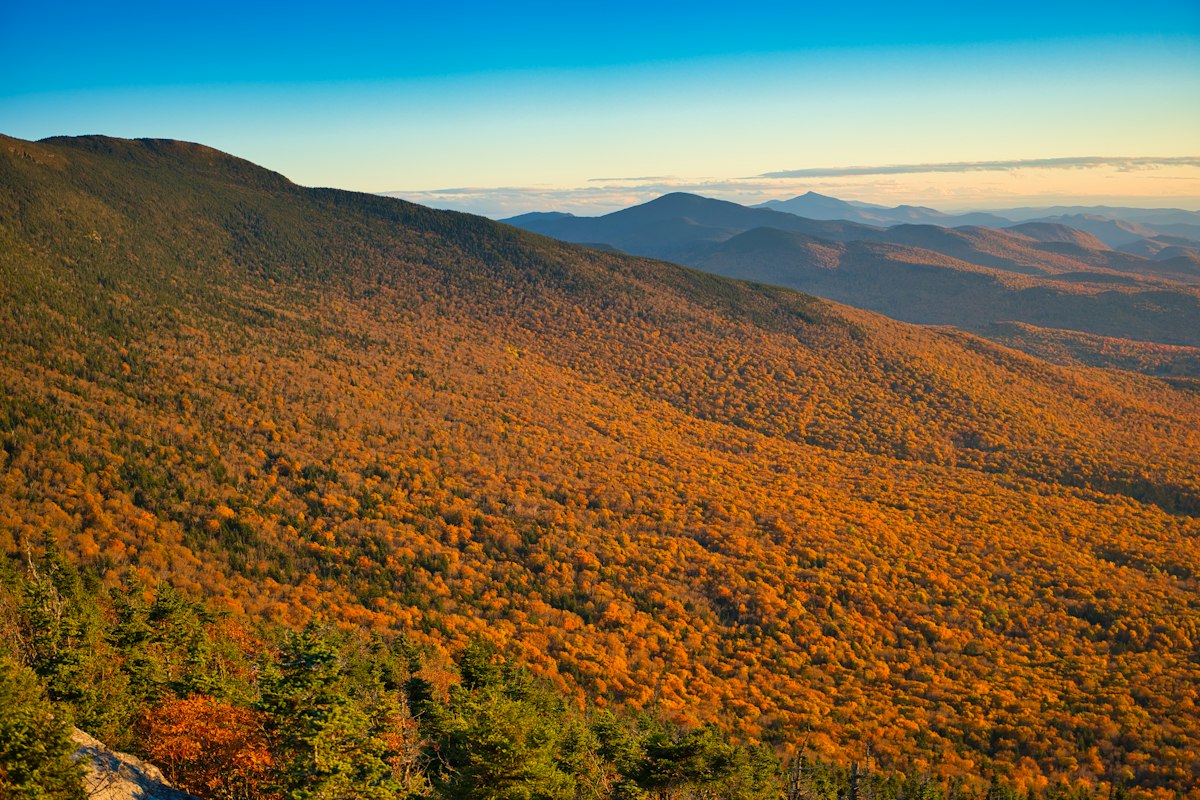
Gold covers the slopes below Mount Mansfield. Photo by Rafael Rodrigues on Unsplash
Two things to know about the drive up. Vermont Route 108 through Smugglers' Notch is a narrow, boulder-walled pass between Mount Mansfield and Spruce Peak, closed to vehicles in winter, so October sits near the end of its season. The Auto Toll Road and the Gondola SkyRide reach the ridge without the hike, but only into mid-October: Go Stowe, the local destination association, gives the gondola's summer and fall season as typically mid-June to mid-October and puts the close for both at October 15. That's a destination organization, not the operator, so confirm on the resort's own alerts page before building the trip around the summit.
The Notch is also where Stowe stops feeling like a postcard and starts feeling like a drive. It's tight, it's slow, and box trucks get stuck in it every year. Take it in daylight.
Vermont in October: What the Second Half Looks Like
If your only free week is mid-to-late October, don't write Vermont off. Move south. By the middle of October, Vermont's weekly reports often have the central and northern mountains past peak while the southern regions and the broader valleys still hold color, with reds lingering on oaks and sumacs. Read the current week's report before you commit to a direction. Bennington, Brattleboro, Manchester and the Route 100 towns below Killington are the late-season play: fewer people, cheaper rooms, color still there.
New Hampshire Fall Foliage Runs a Few Days Behind Vermont
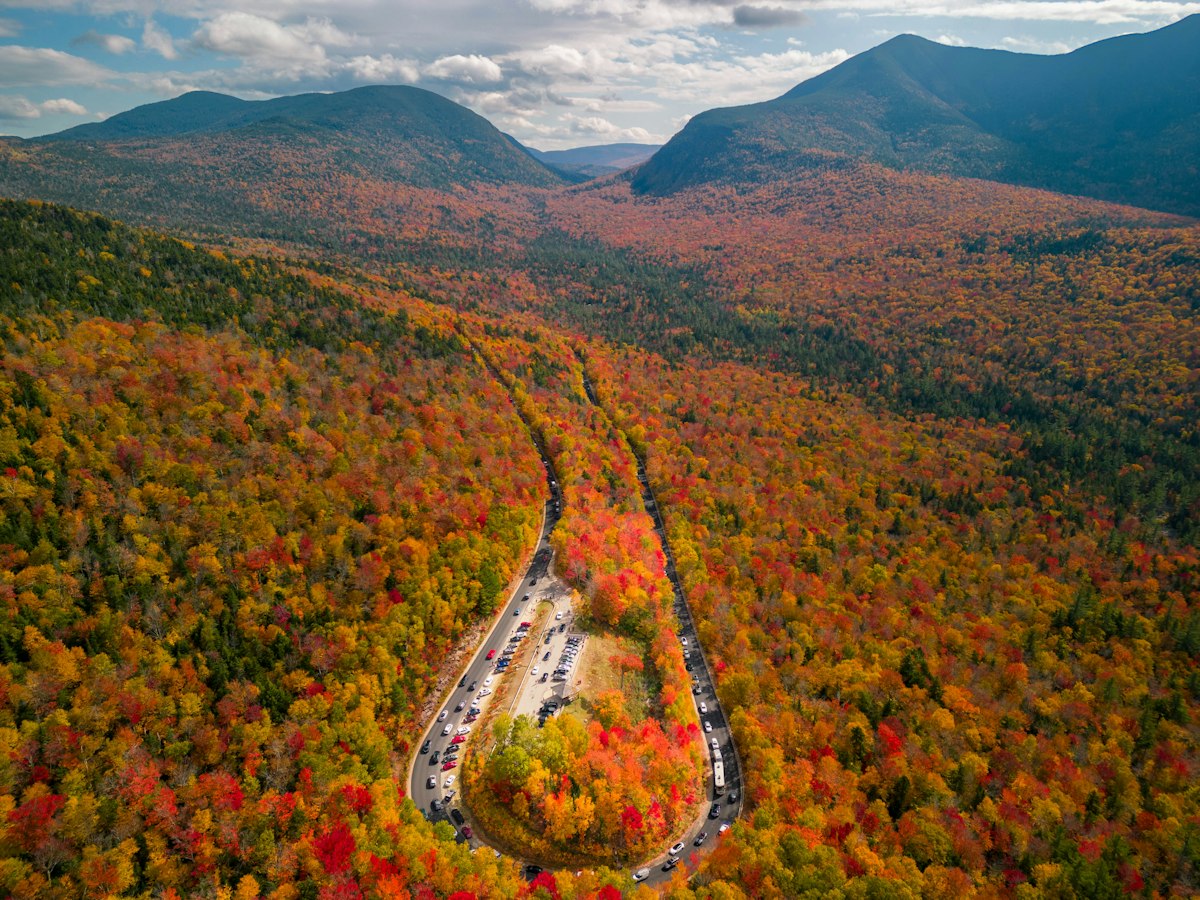
The Kancamagus Highway bends through the White Mountains. Photo by Jonathan Ng on Unsplash
White Mountains fall foliage runs on a slightly later clock than northern Vermont. The White Mountains Attractions Association states that peak foliage typically occurs there from the end of September through the second week of October, and that colors can hang on another week or two after an area peaks. The Great North Woods, up near the Canadian border, goes earlier, in the last week of September.
Fly into Manchester-Boston Regional (MHT). North Conway is about 106 miles and a little over two hours north, the natural base on the eastern side of the notches. Lincoln anchors the western side.
The drive that connects them is the Kancamagus Highway, and it earns the reputation. It runs about 34.5 miles along New Hampshire Route 112 between Conway and Lincoln through the White Mountain National Forest, climbing to 2,855 feet at Kancamagus Pass and then following the Swift River for the next 21 miles, per the National Forest Foundation, which also notes there are no developed amenities along it: no gas stations, restaurants, hotels or other businesses. Fill up first.
For elevation, the Mount Washington Auto Road climbs 7.6 miles to the 6,288-foot summit, New England's highest point. Its published rates are $36 per adult aged 13 and up, $15 per child aged 4-12 and free for toddlers, paid at the Toll House with no reservation, and its season calendar runs into the first days of November, weather permitting. Franconia Notch on I-93 gives similar views without the toll.
Pro tip: Drive the Kancamagus west to east, starting from Lincoln in the morning. The overlooks are staggered so the sun is behind you for most of them, and you beat the North Conway traffic that builds from late morning onward.
Maine Fall Foliage: Portland, the Mountains, Then the Coast
Maine color follows a clean north-to-south progression, which makes it the easiest state to time. Maine's Department of Agriculture, Conservation and Forestry states that peak conditions in northern Maine typically arrive in the last week of September and continue into the first week of October, that central Maine and the western mountains usually peak around Indigenous Peoples' Day weekend, and that coastal and southern Maine generally sees peak or near-peak foliage from mid-October through the end of the month.
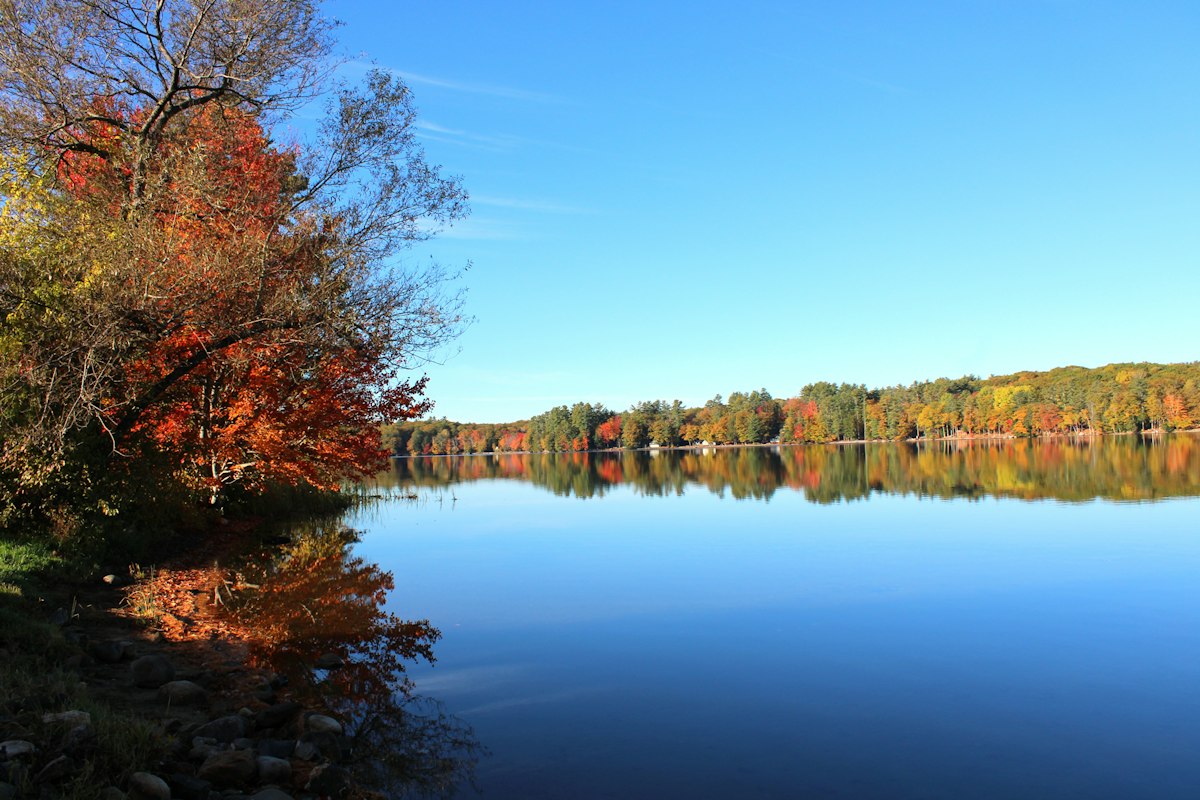
A red maple leans over a still Maine lake. Photo by John Giordano on Unsplash
Portland International Jetport (PWM) covers all three. Bethel and the western mountains sit about 65 miles out, roughly an hour and 40 minutes; Camden and the midcoast about 84 miles. Bar Harbor and Acadia are a longer haul but reward the late-October window, when the coast is finally turning and the summer crowds are gone.
Acadia has one logistic that catches people out. The National Park Service requires a $6 vehicle reservation to drive the Cadillac Summit Road from mid-May to mid-October, sold in advance on Recreation.gov on top of your park pass, with 30 percent of slots released 90 days ahead of each date and the remaining 70 percent at 10 a.m. Eastern two days ahead. Which means a late-October Acadia trip, the exact window when the coast is at its best, generally falls outside the reservation season.
Pro tip: Going in early October instead? If the 90-day Cadillac slots are gone, set an alarm for the 2-day release. That second batch is 70% of the inventory and far less picked over than people assume.
The Berkshires Close the Season in Late October
Berkshires fall foliage is the answer for anyone who can't get away until the back half of October. Massachusetts DCR's forestry staff predict peak by area on an interactive foliage map, basing it on current conditions and past-year data. Most of the state lands in mid-October, with parts of western Massachusetts a touch earlier and pockets running later.

Autumn color rings a western Massachusetts town. Photo by Yilei (Jerry) Bao on Unsplash
The drive here is the Mohawk Trail. It opened in 1914 as one of the first auto-touring roads in the country and became the state's first designated scenic autoroute, and the byway now covers 69 miles along Route 2, per the Western Massachusetts Scenic Byways program. It runs from the Connecticut River Valley into the Berkshire hills and, after the famous hairpin turn at Clarksburg, drops into the Hoosic River valley at North Adams.
Boston Logan (BOS) is the practical gateway: Lenox is about 133 miles west on the Massachusetts Turnpike, roughly two and a half hours. That makes Boston a two-for-one. Pair the Berkshires with city days using the best time to visit Boston and where to stay in Boston, and if your dates land near Halloween, Salem is a day trip from Boston worth its own plan.
Late October in the Berkshires falls well after the summer music festivals that keep Lenox and Stockbridge full, so rooms there run below their July and August rates while the color is at its best.
Doing the Drive With Kids
The fly-and-drive plan above works fine with a car seat in the back, but the legs are not interchangeable. Burlington to Stowe is 45 minutes, the shortest airport-to-color hop in New England. Manchester to North Conway is more than two hours, so plan a stop instead of pushing through. Portland to Bethel is an hour and 40 minutes.
One stretch needs real planning. The Kancamagus has no gas stations, restrooms or food along its 34.5 miles, so top off the tank and use the restrooms in Lincoln or Conway before you start it.
Family constraint | The move | Why it works |
|---|---|---|
A school holiday weekend is the only window you get | Central or western Maine, or the White Mountains | Indigenous Peoples' Day weekend is the published peak for the Maine mountains and the back end of the White Mountains window |
Small kids who fade after an hour in the car | Fly into BTV, base in Stowe or Waterbury | 45 minutes from the gate to maples, the shortest hop in the region |
Somebody wants a summit view, nobody wants a hike | Stowe's Gondola SkyRide, or the Mount Washington Auto Road | Both ride or drive to the top. The Auto Road runs $36 per adult, $15 per child aged 4-12, free for toddlers |
Half a day, not a whole one | Franconia Notch on I-93 instead of the full Kancamagus | Similar notch views off a main road, without the 34.5-mile run with no services |
Family adjustments to the fly-and-drive plan above. Drive times, rates and peak windows are the same published figures cited earlier in this article.
One tradeoff worth saying out loud: Indigenous Peoples' Day weekend is both the peak window for the Maine mountains and the busiest weekend of the season, so rooms go first and the two-night minimums are strictest. If the school calendar gives you any weekday flexibility around it, take it.
What Should You Book First, and When?
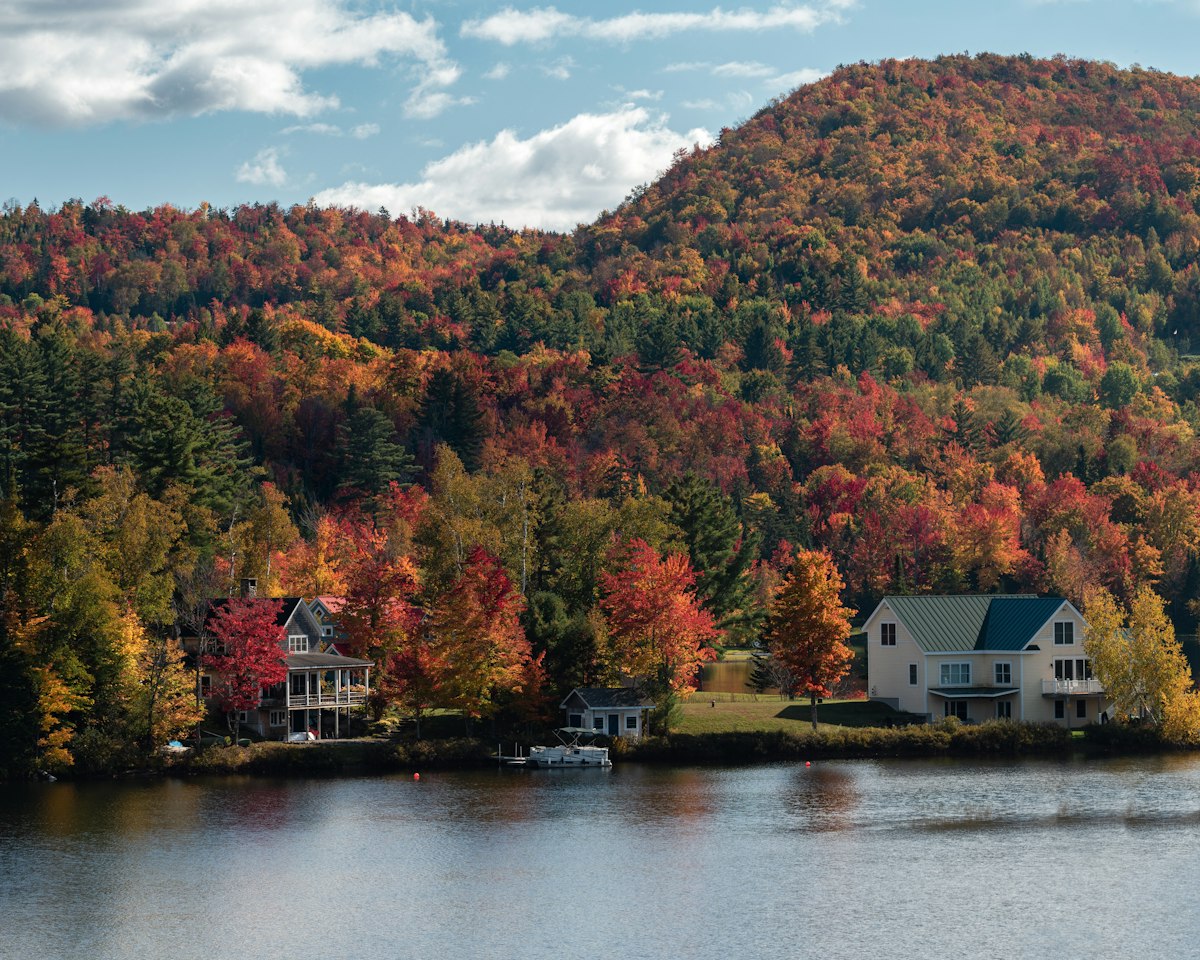
Houses sit below a hillside turning red and orange. Photo by Abhi Verma on Unsplash
Fly into | Drive to | Distance | Base towns | Typical peak window |
|---|---|---|---|---|
Burlington (BTV), Vermont | Stowe, via I-89 to Exit 10, then VT Route 100 N | ~34 mi, ~45 min | Stowe, Waterbury, Burlington | Late September to early October |
Manchester (MHT), New Hampshire | North Conway or Lincoln | ~106 mi, ~2 hr | North Conway, Lincoln, Jackson | Late September to the 2nd week of October |
Portland (PWM), Maine | Bethel, or Camden | 65 mi / 84 mi | Bethel, Camden, Bar Harbor | Indigenous Peoples' Day inland, mid to late October on the coast |
Boston (BOS), Massachusetts | Lenox, via the Massachusetts Turnpike | ~133 mi, ~2.5 hr | Lenox, Great Barrington, North Adams | Mid-to-late October |
Fly-in and drive plan for a New England fall foliage trip. Airport-to-base figures are approximate road distances and driving times. Peak windows are the typical ranges published by each state's forestry or tourism agency, linked in the table above, and are not a forecast for any single year.
Book rooms first and book them early. Inns in Stowe, North Conway and Lenox are the constraint here, not airfare, and the good ones fill months ahead for October weekends with two-night minimums attached. If they're gone or the minimums don't fit your dates, city hotels in Burlington and Portland are the pressure valve: normal chains, one-night stays, and rates that don't spike the way a Stowe or Lenox inn's do that weekend. If you're picking between two towns on price, how to find the lowest hotel rates covers the booking-window mechanics. BTV, MHT and PWM are small airports with fewer daily options and sharper price swings than Boston, so read how to find cheap flights before assuming Boston plus a four-hour drive is cheaper.
A car isn't optional. Transit doesn't reach the Kancamagus or Route 100 in any useful way, and the whole point is being able to pull over. If you're driving up from New York or Philadelphia rather than flying, we ran the drive-or-fly numbers. Reserve through Enterprise, Hertz or Avis as soon as your dates are set, because foliage weekends drain airport fleets in Burlington and Portland especially.
For the rest, describing what you want in plain language beats 30 open tabs. Zenvoya's AI trip planner can line up flights, hotels and experiences in one conversation, then adjust when you decide to chase the color one state south.
Ready to Plan Your Foliage Week?
You've got the calendar. The rest is a flight into Burlington, Manchester, Portland or Boston, a hotel in the right town, and the willingness to drive an extra hour south if the foresters say the line has moved. Plan it with Zenvoya's AI travel agent: tell it which week you're free and which airport works, and let it build the trip around the window instead of the other way around.
The Short Version
Stop hunting for the perfect weekend. Match your week to the right latitude instead: late September and early October for northern Vermont, the Great North Woods and the White Mountains; mid-October for central New England and the Maine mountains; late October for the Berkshires and the coast. If none of those weeks work, other fall travel destinations run on entirely different calendars.
And go on a Tuesday if you possibly can. The road that's bumper to bumper on Indigenous Peoples' Day weekend is empty 48 hours later, and the leaves don't know what day it is.