
Oaxaca or Mexico City for Day of the Dead? Compare crowds, cost, access and the cemetery vigils, then see which city you can still book late.
Almost everyone deciding where to celebrate Day of the Dead lands on the same two options, and then stalls. Oaxaca or Mexico City. Both are real answers. They aren't the same trip, and the thing that separates them isn't which one is "better," it's which one you can still get into and what you want to be standing in front of at midnight on November 1.
Here's the honest version. Día de Muertos falls on November 1 and 2 every year, which in 2026 means a Sunday and a Monday. That's about six weeks out. Oaxaca's small hotel inventory has been filling since spring. Mexico City's hasn't, because Mexico City is enormous. That single fact decides this for a lot of people before preference ever enters the picture, which is why the comparison below starts with access rather than atmosphere.
Both cities are also easy trips to build. Nonstop flights and hotels in each are straightforward to book together, and Zenvoya can hold the whole thing in one conversation, which matters more than usual when you're working against a hard date.
At a Glance: Oaxaca gives you the most traditional, community-rooted observance and the hardest lodging to secure. Mexico City gives you scale, far easier access, a 10th-edition parade confirmed for Saturday, October 31, 2026, and real availability six weeks out. And if you're holding out for Oaxaca's official program before you commit, stop: in 2025 that program wasn't published until October 8, weeks after the good rooms were gone. Late planner? Mexico City. Booked early and want the vigils? Oaxaca.
What are you actually attending?
Día de Muertos is a religious and cultural observance in which Mexican families welcome back and honor relatives who have died. It centers on home altars and cemetery vigils on November 1 and 2, and UNESCO recognizes it as intangible cultural heritage. It is not a costume holiday, and it is not a Mexican version of Halloween.
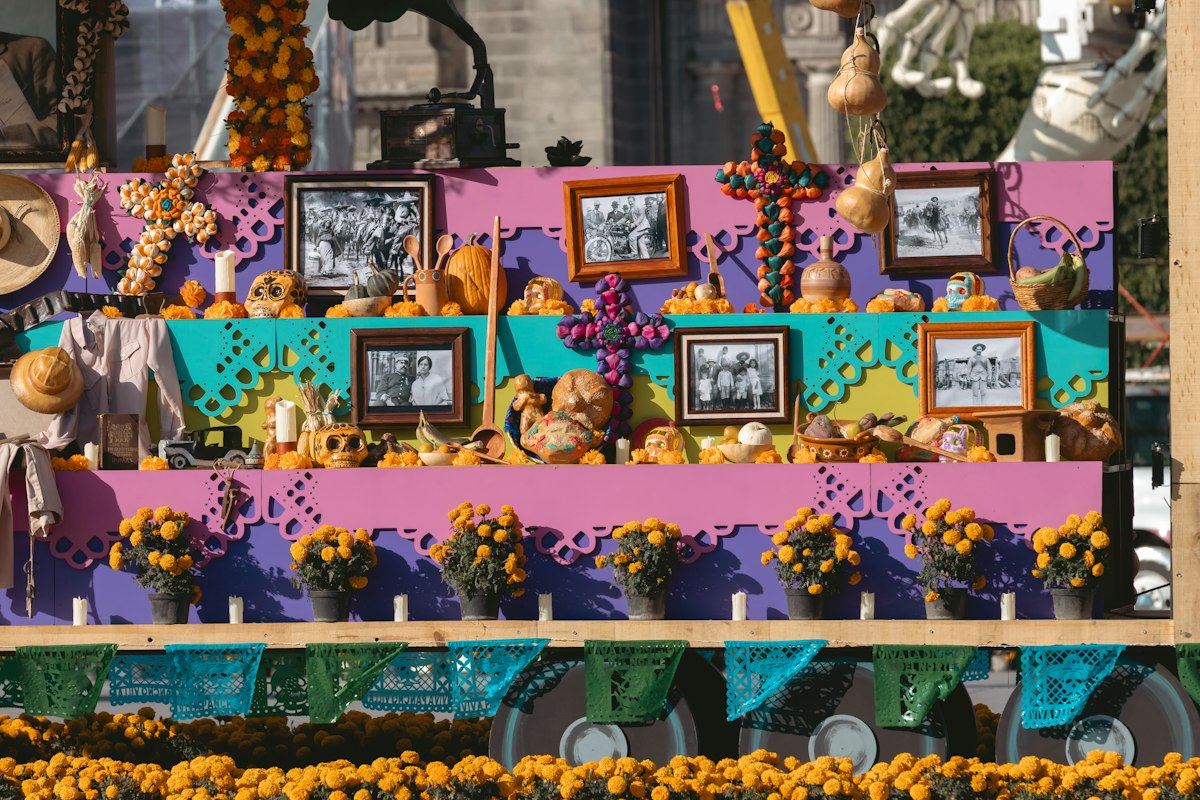
Framed portraits, marigolds and papel picado on a community ofrenda. Photo by Roger Ce on Unsplash
This part matters more than any logistics in this article, so it goes first. UNESCO proclaimed Mexico's Indigenous festivity dedicated to the dead a Masterpiece of the Oral and Intangible Heritage of Humanity in 2003 and incorporated it into the Representative List of the Intangible Cultural Heritage of Humanity in 2008. UNESCO's own description is the clearest short account of what you'll see: families "facilitate the return of the souls to Earth by laying flower petals, candles and offerings along the path leading from the cemetery to their homes," and the deceased's favorite dishes are "placed around the home shrine and the tomb alongside flowers and typical handicrafts, such as paper cut-outs."
The Smithsonian's National Museum of American History puts the other half of it plainly in a piece titled "Day of the Dead at the Smithsonian: It's not Halloween". Different holiday, different roots, different meaning, and the two land days apart on the calendar by coincidence of the Catholic feast days.
The structure is consistent across most of Mexico: November 1 honors children who have died, November 2 honors adults, and the vigils that draw visitors happen in cemeteries on the nights in between. You will be standing a few feet from families sitting at their parents' and children's graves. Plan accordingly, and read the etiquette section below before you go.
Oaxaca: the observance at close range
Oaxaca de Juárez is the answer most people have in their heads when they picture this, and it earns it. The city is compact, walkable, and surrounded by valley towns where the observance has never been a performance for anyone.
The center fills with comparsas, neighborhood processions with brass bands that move through the streets after dark, and the state mounts a large public program under the name La Fiesta Más Viva de Todas. For 2025, that program carried more than 140 cultural and gastronomic events spread across the capital, the Central Valleys, the state's Pueblos Mágicos and the coast, with 95% of them free, according to Mexico's federal Secretaría de Turismo. Expect a similar shape in 2026.
The vigils are the reason to come. Panteón General sits about 20 minutes on foot from the Zócalo and is the most convenient. Xoxocotlán, a short taxi ride south, is the famous one, with an old cemetery and a newer, larger one, and it peaks on the night of October 31. Santa María Atzompa draws a smaller crowd and graves decorated with the town's green-glazed ceramics. Teotitlán del Valle, out in the Tlacolula Valley, is quieter still and the most clearly a community's own night rather than a visitor's.

A marigold cross laid among corn, fruit and candles. Photo by Chris Luengas on Unsplash
Now the constraint, and the state's own numbers show exactly how tight it is. For the 2025 season, Sectur Oaxaca projected hotel occupancy of 73.63% in Oaxaca de Juárez from October 26 to November 3, 2025, against 58.91% across the state as a whole, with 89,834 visitors expected in the capital and an estimated 381 million pesos in spending, up 5.86% on 2024.
That gap between the two percentages is the whole story, and almost nobody reads it. The capital ran roughly 15 points hotter than the state average in 2025, and the Centro Histórico runs hotter still than the capital average, because a city-wide figure folds in properties out along the ring road and toward the airport that nobody planning this trip actually wants. A 73.63% average doesn't mean one room in four was available in the walkable center. It means the periphery was soft while the center was effectively full.
Pro tip: Getting into Oaxaca is easier than it looks. American flies nonstop from Dallas-Fort Worth and Phoenix, United from Houston, and Volaris from Los Angeles, per FlightConnections route data checked in September 2026. If the nonstop is gone, Mexico City connects onward to OAX all day.
Why waiting for the official program is the mistake
Here's the insight that costs people this trip, stated plainly: Oaxaca's official Day of the Dead program is not published until after the practical booking window has already closed, so waiting for the schedule before you book is the single most expensive way to plan this trip.
The 2025 season is the proof. The cultural agenda for La Fiesta Más Viva de Todas was presented at a press conference led by Governor Salomón Jara Cruz and announced by the federal Secretaría de Turismo on October 8, 2025. That's 23 days before the October 31 vigil at Xoxocotlán and 24 days before November 1. Sectur Oaxaca's occupancy and visitor projection for that same season followed on October 17, 2025, two weeks out.
By early October, the rooms that make Oaxaca worth doing, the ones in the Centro Histórico and Jalatlaco you can walk home to at 2 a.m., have been gone for months. So the schedule arrives to an audience that has already either committed or lost the chance. As of mid-September 2026, the 2026 program isn't out yet, and there's no reason to expect it earlier.
The practical consequence: book the city first and the specifics later. Nothing in the program changes the answer to "Oaxaca or Mexico City," because the vigil nights, the comparsas and the cemeteries are fixed by the calendar and by tradition, not by a cartelera. The program tells you which free concert is on Tuesday. It doesn't tell you anything you need in order to decide.
Planning milestone | When it actually happens | What it means for you |
|---|---|---|
Oaxaca Centro Histórico rooms sell out | Spring through summer, months ahead | The decision has to be made before any official schedule exists |
Oaxaca's official program published | October 8 in 2025, 23 days before the first vigil night | Arrives after the good rooms are gone; not a decision input |
Oaxaca occupancy projection released | October 17 in 2025 | Confirms the squeeze rather than warning you about it |
CDMX parade date confirmed | Confirmed for Saturday, October 31, 2026 (10th edition) | The one fixed date available to plan around early |
CDMX parade route and start time | Not published as of mid-September 2026 | Book the city now, choose the hotel block once the route posts |
The vigil nights themselves | October 31 at Xoxocotlán; November 1 and 2 citywide | Fixed by the calendar every year, never subject to announcement |
Oaxaca program and projection dates from Mexico's federal Secretaría de Turismo (October 8, 2025) and Sectur Oaxaca (October 17, 2025); 2026 parade date per El Universal. Sell-out timing reflects observed inventory patterns in Oaxaca's historic center, not an official figure.
Mexico City: scale, access, and a parade that started with a movie
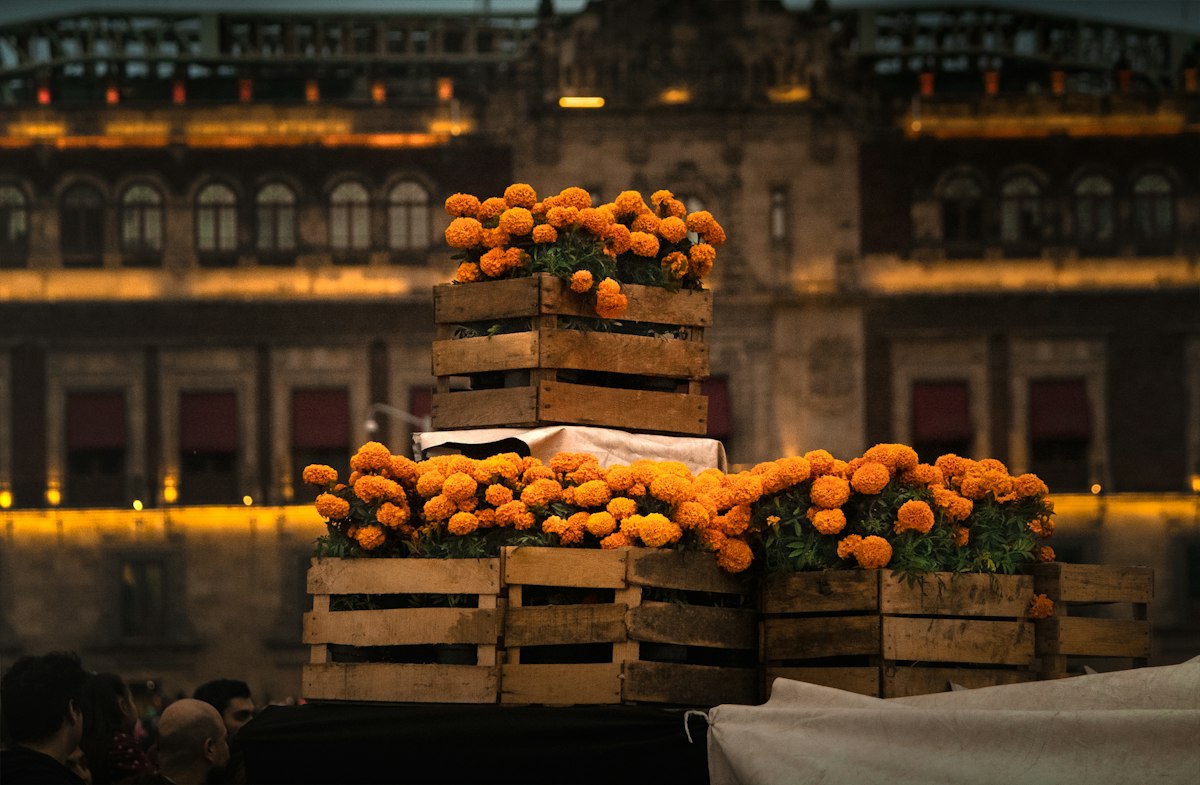
Crates of cempasuchil marigolds stacked before a floodlit palace. Photo by Kevin Quezada on Unsplash
Mexico City is the option people underrate because they assume bigger means less real. What it actually means is that the traditional observance and the modern spectacle happen in the same week, in different places, and you can see both.
The spectacle is the Gran Desfile de Día de Muertos, and its origin is worth knowing. There was no citywide Day of the Dead parade in Mexico City before 2016. The capital staged its first one on Saturday, October 29, 2016, and as the Associated Press reported at the time, the idea came from a scriptwriter for the 2015 James Bond film Spectre, whose opening sequence was shot in Mexico City and depicted a parade that didn't exist. Lourdes Berho, then CEO of the government's Mexico Tourism Board, explained the reasoning in that report: the film "started to create expectations that we would have something."
Tens of thousands watched that first edition. It has since become genuinely popular on its own terms, and the Mexico City government counted more than 1.45 million people along the route in 2025, as reported by El Universal. It's a modern civic creation, not an ancient rite, and knowing the difference is most of what separates a good visit from a confused one.
For 2026, the city's Secretaría de Cultura has confirmed the 10th edition for Saturday, October 31, 2026, as reported by El Universal, which also notes the parade is free to attend and is built around three themes: pre-Hispanic roots, expressions of popular culture, and tributes to figures from Mexican culture. The start time and final route had not been published when this article went up. Previous editions have run from the Puerta de los Leones in Bosque de Chapultepec along Paseo de la Reforma to the Zócalo, and the CDMX Secretaría de Cultura is the channel that posts confirmed details. Check it before you pick a hotel on the route.
The traditional side is out in the boroughs. San Andrés Mixquic, in Tláhuac at the city's southeastern edge, holds the mass candle-lighting in its churchyard cemetery on the night of November 2 that is commonly called the Alumbrada, and it's one of the most photographed sights in the country. The Mexico City government's visitor site describes the town as most famous for its Day of the Dead celebrations, puts it at "just under 40 minutes" by taxi from Metro Tláhuac, and warns that most visitors are not permitted inside the cemetery after about 10 p.m. on the night of November 2. Plan to be there early. Xochimilco and Iztapalapa run their own observances, and monumental ofrendas go up across the city with the largest on the Zócalo.
Access is the quiet argument for Mexico City. Benito Juárez International lists nonstop service from 19 US airports, led by Houston, Los Angeles, Chicago, Dallas-Fort Worth and Miami and reaching down to Austin, Boston, Minneapolis and Salt Lake City, per FlightConnections route data checked in September 2026. Oaxaca has four. More seats, more fare competition, more hotel rooms, more room to change your mind.
Pro tip: Stay in Roma Norte, Juárez or Condesa rather than on Reforma itself. You'll be a short walk from the parade route without being trapped behind barricades on the day.
Oaxaca vs Mexico City: which one should you pick?
Pick Oaxaca for the most traditional observance, if you already have a room in or near the historic center. Pick Mexico City if you're booking within roughly two months of the date, want easier flights, or want both the October 31 parade and traditional cemetery vigils on the same trip. Access, not atmosphere, is usually the deciding factor.
Oaxaca de Juárez | Mexico City | |
|---|---|---|
Crowds | Concentrated and intense in a small historic center; cemeteries at Xoxocotlán can be shoulder to shoulder on the night of October 31 | Large in absolute terms but spread across a city many times the size of Oaxaca's historic center; the parade crowd and the Mixquic crowd are in different places on different nights |
Cost and availability | The binding constraint. Centro Histórico rooms go months ahead. Sectur Oaxaca projected 73.63% capital occupancy for October 26 to November 3, 2025, versus 58.91% statewide | Real availability six weeks out. Far larger room inventory and more nonstop fare competition into MEX |
How traditional the observance is | Highest. Community vigils at Panteón General, Xoxocotlán, Santa María Atzompa and Teotitlán del Valle, plus street comparsas | Mixed by design. Traditional vigils at Mixquic and in the southern boroughs, alongside a civic parade first staged in 2016 after the 2015 film Spectre |
Difficulty of access | 4 US nonstop routes as of September 2026: Dallas-Fort Worth and Phoenix on American, Houston on United, Los Angeles on Volaris. Otherwise connect through MEX | Nonstop service from 19 US airports as of September 2026, the widest US access of any Mexican airport |
What the official calendar tells you | Little, and late. The 2025 program was published October 8, 2025, 23 days before the first vigil night | The parade date is confirmed far in advance (October 31, 2026); route and start time post closer in |
What you actually see | Comparsas with brass bands through the streets after dark, candlelit graves, marigold fields, valley towns | The 10th-edition parade on October 31, monumental ofrendas citywide, and the Alumbrada at Mixquic on the night of November 2 |
Best for | Travelers who booked early and want the observance at its most community-rooted | Late planners, first-timers, and anyone who wants both the traditional and the civic side in one trip |
Occupancy, visitor and spending figures from Sectur Oaxaca's October 17, 2025 projection for the 2025 season; program publication date from Mexico's federal Secretaría de Turismo, October 8, 2025; nonstop route counts from FlightConnections, checked September 2026; 2026 parade date and themes per El Universal; 2016 parade origin per the Associated Press. Oaxaca figures are 2025 season projections and have not been restated for 2026.
How should visitors behave in a cemetery?
Treat a vigil as a family's private remembrance that you have been allowed to stand in. Ask permission before photographing any person, keep your flash off, leave the tripod at the hotel, and never bring alcohol into a cemetery. Buying marigolds or candles from the vendors outside and leaving them is always welcome.
You are a guest at a family's remembrance. That's the whole rule, but a few specifics help.
Do | Don't |
|---|---|
Ask before photographing any individual, especially anyone in traditional dress or face paint | Point a lens into someone's face, or shoot a family at a grave without asking |
Take wide shots of the cemetery, and keep flash off | Set up a tripod at a graveside |
Walk slowly, greet people, accept an invitation to sit if one is offered | Arrive drunk or bring alcohol into a cemetery |
Buy marigolds or candles from the vendors outside and leave them | Treat face paint as a costume you wear to observe other people's grief |
Etiquette guidance drawn from long-running community reporting on visitor behavior at the Teotitlán del Valle cemetery by Oaxaca Cultural Navigator.
The short version: a wide, quiet shot of a cemetery full of candles is fine. A close portrait of a stranger crying at a grave is not, and no amount of camera quality changes that. Note too that the Mexico City government's own guidance for Mixquic closes the cemetery to most visitors after roughly 10 p.m. on November 2, which is a reminder that these sites are managed for the families first and the visitors second.
Pick Oaxaca if, pick Mexico City if
Pick Oaxaca if you already have a room, or you're willing to stay in Reforma or San Felipe rather than the Centro and taxi in. Pick it if the reason you're going is the vigils, the comparsas and the valley towns, and if you'd rather see one thing deeply than three things broadly. Pick it if you can build the trip around October 31 at Xoxocotlán and November 1 and 2 in the city. And pick it without waiting for the program, because the program will arrive in early October and tell you nothing that changes your mind.
Pick Mexico City if you're reading this in September and starting from zero. That's not a consolation prize. The city has the October 31 parade and monumental ofrendas across its center, and on the night of November 2 the community at Mixquic holds the Alumbrada, which is as traditional as anything in Oaxaca and rarely described that way. You also get nonstop service from 19 US airports, thousands of hotel rooms, and the ability to book flights and hotels together on a normal timeline instead of a frantic one.
One paragraph on the smaller places, because they come up constantly: Pátzcuaro and the island of Janitzio in Michoacán hold the candlelit lake vigil that appears in most of the photography, and it's extraordinary, but it means flying to Morelia or Guadalajara and driving, plus lodging in an even smaller town than Oaxaca. Mixquic is the one that's actually easy, because it's inside Mexico City. If you're weighing Pátzcuaro seriously, plan it for next year and go to Mexico City this time.
Ready to plan your Día de Muertos trip?
You've got about six weeks, one immovable date, and two cities where the good rooms move fast. That's exactly the kind of trip that falls apart in a spreadsheet.
Describe what you want in plain language and Zenvoya's AI trip planner will put the flights, hotels and experiences together in one conversation, and rework the plan with you if you change the dates or the city. Six weeks out against a date that will not move is exactly the case an AI travel agent is built for. If fares are your sticking point, our guides to finding cheap flights and locking in lower hotel rates are the right starting point.
The bottom line
The real question isn't which city does Día de Muertos better. It's which city you can still do it in, and what you want the memory to be. Oaxaca is the one you plan in April. Mexico City is the one you can still plan today, and if you go, the Alumbrada at Mixquic on the night of November 2 is where you'll understand what the observance actually is.
Pick your city this week, book the flight and the room in the same sitting, and spend the remaining six weeks reading about what you're going to see rather than refreshing availability. Above all, don't spend those weeks waiting on a program that, on last year's timing, won't exist until three weeks before the date. If you're still weighing the season generally, our roundup of the best fall travel destinations covers the rest of the window.

Papel picado and a sawdust carpet fill a colonial lane. Photo by Edgar Cavazos on Unsplash