
Is Costa Rica expensive? A week runs about $2,400-4,000 for two before flights. See where the money goes for couples, friend groups and families.
At a Glance
Yes, Costa Rica is expensive by Central American standards, though usually cheaper than Hawaii. US visitors spent about $171 per person per night if they flew home from San José, and $287 if they flew home from Liberia, per 2025 departure surveys by the Costa Rican Tourism Institute (ICT) at the San José and Liberia airports. Over a week, that's roughly $2,400-4,000 for two, before flights.
A comfortable week with flights: about $2,250-2,550 per person in the three budgets below, or $242-282 a day once you're on the ground.
A leaner week works too: $1,000 a person covers seven nights in one base before flights, about $143 a day, if you share a simple hotel room and eat at sodas (local diners).
Beach weeks cost more: in the same ICT surveys, Americans leaving through Liberia, the airport for the Guanacaste beaches, spent 68% more per night than those leaving through San José.
Pricier than its neighbors: consumer prices run about 62% of the US level, the highest in Central America, based on World Bank data for 2025.
Extras set by law: 13% sales tax (IVA, per Costa Rica's Ministry of Finance) plus a 10% service charge under Law 9116 on sit-down restaurant bills, and $16.95-18.08 entry, tax included, at Arenal Volcano or Manuel Antonio for foreign adults under Executive Decree 38295-MINAE.
Costa Rica has a reputation as the easy tropical trip: a volcano hike in the morning, the beach by the weekend. Then you start pricing it. Park tickets are set in dollars, restaurant bills carry a tax and a service charge, and the zip-line you saved on Instagram costs $93 a person at Sky Adventures.
So, is Costa Rica expensive to visit? Next to its neighbors, yes. Next to Hawaii, usually not. Below, one week is priced three ways (a couple, four friends and a family of four) from official park fees, published operator rates and the government's own visitor-spending surveys. After that: why prices run high, which month is cheapest and whether $1,000 a week holds up.
Flights, hotels and experiences make up about 40-50% of each week priced below. Zenvoya, an AI trip planner, plans, books and changes all three in one conversation, including a hotel in each town you stay in. The rest (meals, park tickets, the shuttle between towns) is laid out here with links to the official rates.
How Much Should You Budget for a Week?
Plan on about $2,250-2,550 per person for a comfortable seven-night trip to Costa Rica with flights, hotels, two paid experiences, park entry and every meal out. Food is the biggest line, at $1,071 a person on an eat-out-every-meal benchmark (the State Department's meals rate), or 42-47% of each group's week, followed by the flight ($562 on Kayak) and the hotel.
Here's that week for a couple, four friends and a family of four.
Per person, 7 nights | Couple (2 bases) | Four friends (1 base) | Family of four (2 bases) |
|---|---|---|---|
Round-trip flight from the US | $562 | $562 | $562 |
Hotel | $515 | $515 | $257 |
Experiences | $129 | $129 | $115 |
National park fees | $35 | $17 | $23 |
Food and incidentals | $1,071 | $1,071 | $1,071 |
Shuttles between towns | $227 | $136 | $227 |
Total per person | $2,539 | $2,430 | $2,255 |
Total for the group | $5,078 | $9,720 | $9,020 |
Per person per day on the ground (no flight) | $282 | $267 | $242 |
All figures per person, rounded to the nearest dollar, as of October 2026; totals are the sum of the rounded lines. Flights: Kayak's average round trip from the US over the past 12 months ($562; typical range $419-788), applied to every traveler. Hotel: the US State Department's $147 maximum nightly lodging rate for Costa Rica (effective June 1, 2026) as a mid-range room benchmark, with one room for the couple, two for the friends and one for the family. Experiences: the Sky Adventures Arenal zip-line ($93 adult, $65 child) plus Mistico's morning hanging-bridges walk ($32 plus 13% tax; Mistico lists free entry only for ages 0-4).
Park fees: non-resident entry under Executive Decree 38295-MINAE, $15 for Arenal Volcano, $16 for Manuel Antonio and $5 for kids ages 6-12, each plus 13% tax; the one-base friends skip Manuel Antonio. Food: the State Department's $153 daily meals-and-incidentals rate, an eat-out-every-meal ceiling. Shuttles: Interbus's lowest listed fares on Busbud ($68 San José-La Fortuna and $69 San José-Manuel Antonio, applied in both directions) and the Arenal-Manuel Antonio shared shuttle on AAA, priced at its $90 headline fare before taxes; kids are priced at adult fares. Per-day row: the per-person total minus the flight, divided by seven.
Take the flights out and the couple's week comes to about $3,950 for two, the top of that $2,400-4,000 range. That's deliberate: this table prices the comfortable version. On the ground, the three groups spend $242-282 per person per day. The couple's $282 lines up with the $287 a night that Americans flying home from Liberia spent, per ICT's Liberia airport survey. Through San José the average was $171, so simpler rooms and local food pull the number down fast.
Three choices move that total more than anything else.
How many bases you book. One base means two shuttle legs. Two bases means three, and the middle one costs you most of a day: on Interbus's published schedule, the La Fortuna to Manuel Antonio shuttle leaves at 7:45 a.m. and takes 5 hours 30 minutes. That's why the four friends, who stay put in La Fortuna, spend $91 less per person on shuttles. A third base such as Monteverde adds another fare and another morning on the road; La Fortuna to Monteverde and Monteverde to Manuel Antonio each run about 4 hours on the same schedule. For a first week, two bases is the sweet spot: Arenal for the volcano and rainforest, then the Pacific for beaches. Zenvoya books the flights and a hotel in each town as one multi-city trip, and plans each day around the time it takes to get between them.
How you move between them. Shared shuttles are the simplest choice for most first-timers, and they're what the table prices. Renting a car buys flexibility, but compare the full total at checkout rather than the headline daily rate, and expect a hold on your card: Adobe Rent a Car asks for a $1,000 guarantee deposit on a credit card and requires drivers to be at least 23. Gas adds up too (more on that below). Short domestic flights on Sansa, which serves both La Fortuna and Quepos-Manuel Antonio, replace the longest drives; weigh the fare against a shuttle seat plus a lost morning.
Who's traveling. Kids save the most on fees and experiences: park entry for ages 6-12 is $5.65 with tax instead of $16.95-18.08, and the zip-line's child rate is $28 below the adult one. Four friends save by splitting rooms. Their cost is coordination, which goes faster when everyone plans from one shared itinerary instead of a group chat full of links. For more on trips with kids, see our family summer vacation planning guide.
Pro tip: Buy Manuel Antonio tickets before you fly. Visit Costa Rica says they're sold only online through SICORE, the ticketing system of SINAC, Costa Rica's national park service. The park closes on Tuesdays for maintenance, per ICT, so don't save it for a Tuesday.

A hiker crosses a misty hanging bridge near La Fortuna. Photo by J. Amill Santiago on Unsplash
Why Is Costa Rica So Expensive?
Costa Rica costs more than its neighbors for four measurable reasons: the highest consumer price level in Central America, a colón that has gained about 44% against the dollar since 2022 (per World Bank and Central Bank of Costa Rica rates), 23% in tax and service on restaurant bills, and park fees for foreigners that are set in dollars.
Start with prices. Using World Bank purchasing-power data and the official exchange rate, Costa Rica's 2025 consumer prices land at about 62% of the US level. Every neighbor comes in lower: Belize is around 54%, Panama 50%, Honduras 49%, El Salvador 47%, Guatemala 45% and Nicaragua 37%. Mexico sits at about 59%.
Then the currency moved. A dollar bought an average of ₡647 in 2022, per the same World Bank series. The Central Bank of Costa Rica (BCCR) reference buying rate is about ₡449 now (see the box below). Your dollar buys about 30% fewer colones, so anything priced locally, from a casado (the rice-and-beans lunch plate at sodas) to a liter of gas, costs about 44% more in dollars than it did in 2022, even if its colón price never changed.
Visitors have felt it. ICT's spending survey of air travelers puts the average visitor at $1,848 over 10.3 nights in 2025, or about $179 a night. That's the highest per-night figure in a series that goes back to 2006, up from about $118 in 2022 and $131 in 2024. Shorter stays explain part of the jump: the average trip shrank to 10.3 nights from 12.2 the year before, while total spending per visitor rose.
Taxes stack on top. Tourism businesses registered with ICT have charged the full 13% value-added tax (IVA) since July 1, 2023, after a phase-in that started at 0%, according to a Ministry of Finance (Hacienda) presentation. At any restaurant, bar or soda with table service, Law 9116 adds a mandatory 10% service charge, calculated on the bill before tax and printed as "Servicio 10%." If a menu price leaves out both, the bill comes out 23% higher.
Parks charge visitors in dollars. Under Executive Decree 38295-MINAE, non-residents pay $16 at Manuel Antonio and $15 at Arenal Volcano and Poás, while residents pay ₡1,600 and ₡1,000. SINAC adds 13% IVA at checkout (Delfino's report on its online ticket sales lists a $15 park at $16.95 for foreign adults), so Manuel Antonio comes to $18.08 and Arenal to $16.95. At the current exchange rate, a foreign adult pays about 4.5 times what a resident does at Manuel Antonio. Plenty of visitors pay it: 55% of Americans leaving through San José had visited a national park, biological reserve or other protected area, per ICT's San José airport survey, against 37% of those leaving through Liberia.
Driving doesn't dodge any of this. Regular gasoline sells for ₡719 a liter under the regulated prices published by RECOPE, Costa Rica's state fuel company. That's about $6 a gallon, roughly 40% above the US national average that AAA tracks.
None of this makes Costa Rica a bad deal. It just means the "cheap Central America" assumption doesn't hold here.
Rates behind these numbers (checked October 15, 2026)
Exchange rate: ₡449.12 buying and ₡453.25 selling per US dollar, the BCCR reference rates. Regular gasoline: ₡719 a liter, RECOPE prices in force since October 3, 2026, or about $6.06 a gallon at the buying rate. US national average: $4.33 a gallon of regular, per AAA.

Rice and beans on a supermarket shelf, priced in colones. Photo by Bernd 📷 Dittrich on Unsplash
What's the Cheapest Month to Go to Costa Rica?
January is the cheapest month to fly to Costa Rica from the US, and October is the cheapest month for hotels in La Fortuna, so the answer depends on which line you're trying to shrink. Kayak's fares for the past 12 months put the average round trip at $506 in January, against $684 in December and $645 in July.
Moving a December trip to January saves $178 a person on airfare, or $712 for a family of four. Rooms follow a different calendar: Kayak's La Fortuna hotel data flags October as the cheapest month and March as the most expensive.
Those months track the seasons. According to the National Meteorological Institute (IMN), the Pacific side has a well-defined dry season from December through March, with April as a transition and March the driest, hottest month. The rains run May through October, with November as the shoulder. IMN also describes a relative dip in rain in July and August, the "veranillo," before September and October bring the Pacific side's heaviest rain. That midsummer break is why Costa Rica shows up on our list of best summer vacation destinations.
The Caribbean side keeps its own calendar. IMN says it has no defined dry season; the coast gets two relatively dry stretches, February-March and September-October, and its rainiest month is December. So the wettest weeks on the Pacific can be some of the better ones in Puerto Viejo and Cahuita.
Holidays are the weeks to lock in early. December has the highest average fare in Kayak's data. Holy Week before Easter is the other one to plan around: Holy Thursday and Good Friday are mandatory paid national holidays, per the Ministry of Labor (MTSS), so plenty of Costa Ricans are traveling too. If December is your window and warm weather is the point, compare Costa Rica with our warm places to travel in December. For how fares and rooms swing in other regions, see our guide to the cheapest time to travel.
Pro tip: Match the month to the coast, not the country. In September and October, IMN's calendar has the Pacific at its wettest while the Caribbean coast is in one of its drier stretches.
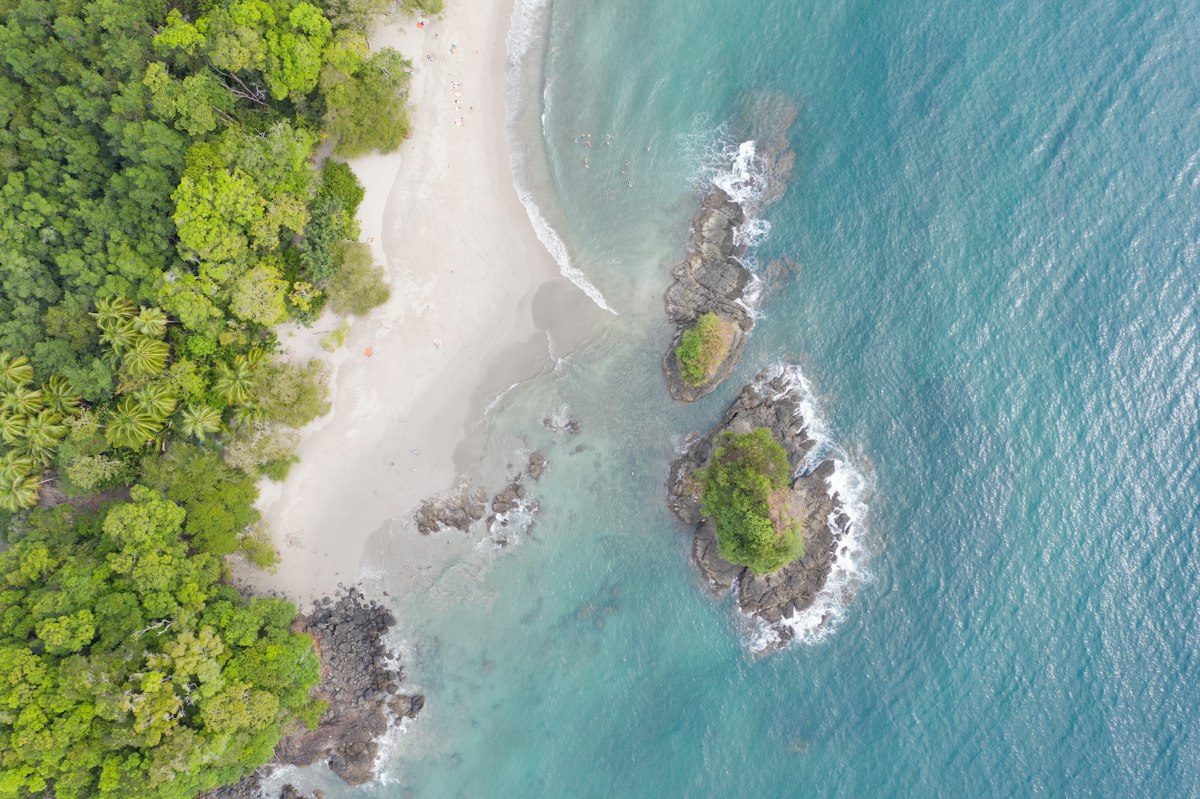
A white-sand beach and rocky islets in Manuel Antonio. Photo by Jonathan Segal on Unsplash
Can You Do Costa Rica on $1,000 a Week?
Before flights, yes, with trade-offs: $1,000 a person covers a green-season (rainy-season) week in one base, about $143 a day, if you share a simple hotel room and eat where Costa Ricans eat. The average US visitor leaving through San José spent about $1,200 a week (ICT's 9-night figure scaled to seven nights), so $1,000 is below average but doable.
Here's a $1,000 week for two friends sharing a room in La Fortuna in the green season.
Per person, 7 nights in La Fortuna | Cost |
|---|---|
Half of a $49-a-night hotel room | $172 |
Shuttle seats, San José to La Fortuna and back | $136 |
Arenal Volcano National Park entry (with tax) | $17 |
Mistico hanging bridges, afternoon walk (with tax) | $32 |
Subtotal | $357 |
Left for food and extras | $643 (about $92 a day) |
As of October 2026, rounded to the nearest dollar. Room: Hotel Las Flores, listed from $49 a night for an October 17-18 stay on Kayak's La Fortuna page; rates change daily. Shuttles: the $68 Interbus fare on Busbud, each way. Park entry: $15 plus 13% tax under Executive Decree 38295-MINAE. Walk: Mistico's $28 afternoon rate plus 13% tax.
That leaves $92 a day for food, drinks and extras, well under the State Department's $153 meals-and-incidentals rate for Costa Rica. It's comfortable if you eat at sodas and shop at grocery stores, and tight if every dinner is at a sit-down place with tax and service added. Add the $93 zip-line and you still have about $79 a day.
With flights included, $1,000 gets hard. Kayak's $562 average round trip leaves $438 for the whole week on the ground. That works only with a well-below-average fare, a shared room and almost no paid experiences, so most people shouldn't plan around it.
If you're close, pull the same levers as the main table: one base instead of two, a rainy-season week instead of a holiday week, and one big experience instead of several.
Pro tip: Do the hanging bridges after midday. Mistico's self-guided walk starts at $28 in the afternoon versus $32 in the morning, both plus 13% tax, on the same 3.2-kilometer (2-mile) trail.
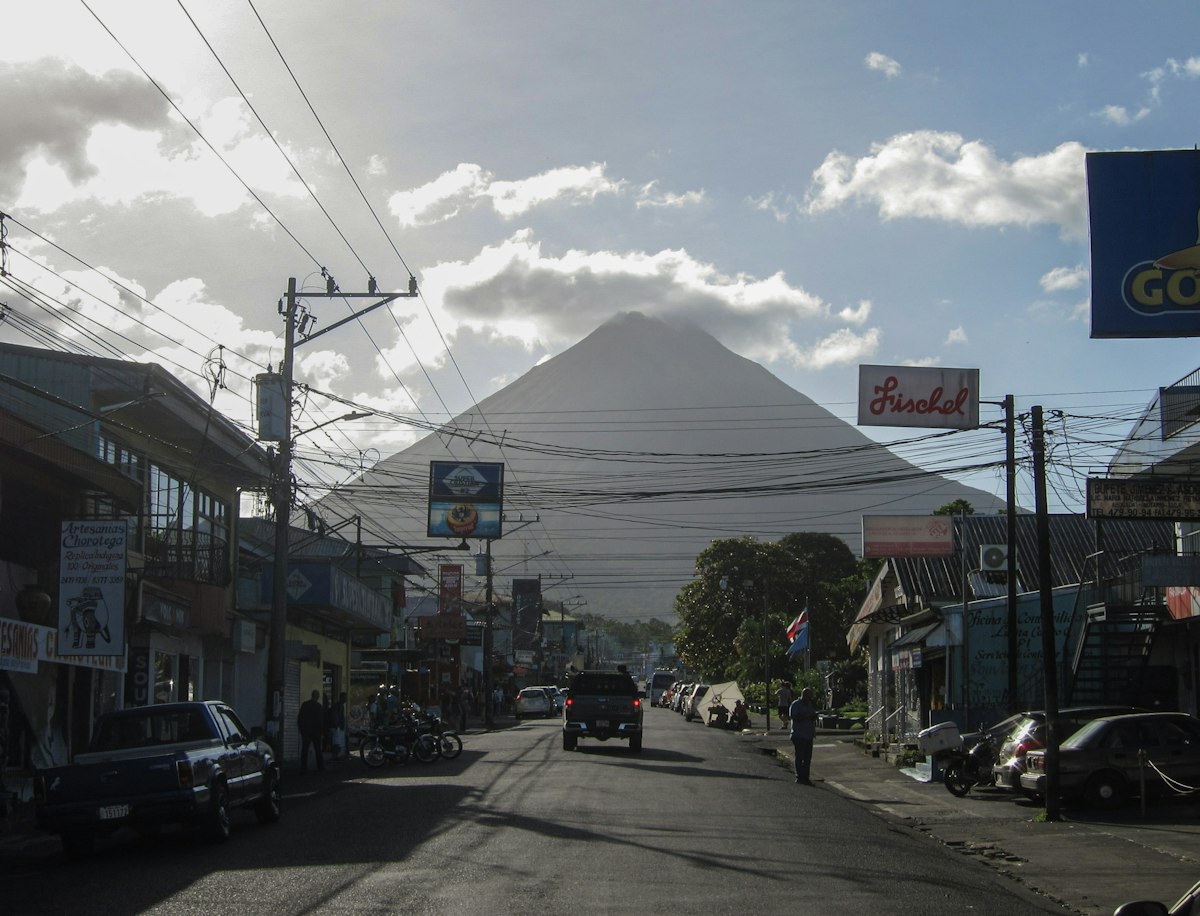
Arenal Volcano rises beyond a shop-lined street in La Fortuna. Photo by Tom Patmore on Unsplash
Is Costa Rica Cheaper Than Mexico or Hawaii?
Costa Rica is usually cheaper than Hawaii, and against Mexico it depends on where in Mexico. At the US State Department's per diem rates for hotels and meals, a week for two costs $3,171 in Costa Rica, less than in Cancún ($3,899), Los Cabos, Puerto Vallarta or Mexico City, but more than in Playa del Carmen ($2,520) or Cozumel.
Everyday prices run a little higher in Costa Rica (about 62% of US levels versus 59% in the World Bank figures above). The per diem rates, which set the maximum hotel and meal allowances for US government travelers abroad, show the split market by market.
Location | Max hotel rate per night | Meals and incidentals per day | Week for two at these rates |
|---|---|---|---|
Costa Rica (all locations) | $147 | $153 | $3,171 |
Cancún, Mexico | $287 | $135 | $3,899 |
Mexico City | $250 | $136 | $3,654 |
Puerto Vallarta, Mexico | $243 | $134 | $3,577 |
Los Cabos, Mexico | $272 | $112 | $3,472 |
Cozumel, Mexico | $182 | $109 | $2,800 |
Mexico, other locations | $141 | $120 | $2,667 |
Playa del Carmen, Mexico | $164 | $98 | $2,520 |
Foreign per diem rates from the US State Department Office of Allowances, publication dated October 1, 2026, as of October 2026. Effective dates vary: Costa Rica June 1, 2026; Mexico City, Puerto Vallarta, Cozumel and other Mexico locations March 1, 2026; Cancún, Los Cabos and Playa del Carmen August 1, 2024. "Week for two" is one room for seven nights plus meals and incidentals for two people for seven days, before flights.
Read it this way: Costa Rica's benchmark hotel rate sits far below Mexico's big resort markets, while its meals rate is higher than any Mexican location on the list. In Cancún, Mexico City, Puerto Vallarta and Los Cabos, the hotel gap wins, so a benchmark week for two costs less in Costa Rica. Playa del Carmen, Cozumel and the rest of Mexico flip that: hotel rates within about $35 a night of Costa Rica's, and much cheaper meals.
Against Hawaii, Costa Rica usually wins, unless your trip looks like the average one through Liberia. US visitors to Hawaii spent about $264 per person per day in 2025, per the Hawaii Department of Business, Economic Development and Tourism (DBEDT); by island, visitors averaged $238 a day on Oahu and $305 on Maui. Americans leaving Costa Rica through San José averaged $171 a night that year. Through Liberia it was $287, which lands between Oahu and Maui.
For the island-by-island Hawaii breakdown, see Is Hawaii Expensive?

Grilled steak with rice and beans, slaw and fried plantains. Photo by Tony Rocket on Unsplash
What Would Your Own Week Cost?
The quickest way to build your own version of the first table is to price the lines you book ahead together. Tell Zenvoya's AI trip planner your dates, home airport, who's coming and whether you want Arenal plus the Pacific, in plain language. It prices and books the flights, a hotel in each base and the experiences you pick in one conversation, and if plans change, you change the booking in the same chat. Traveling as four friends? Everyone plans from the same itinerary. It's free to use; you pay only for what you book.
A free sign-up also unlocks member pricing, built on Zenvoya's supplier and fare agreements, so the flight and hotel can cost less than on typical booking sites.
So, Is It Worth the Money?
Costa Rica isn't a cheap trip, and the stronger colón has made it pricier in dollars. But the money buys a lot in a small country. Arenal Volcano, the Monteverde cloud forest and the beaches at Manuel Antonio are no more than 5 hours 30 minutes apart by shared shuttle, and there's a whole second coastline on the Caribbean side.
A comfortable week runs about $2,250-2,550 per person with flights and every meal out. Pick one base, eat at sodas and fly in January, and you'll come in well under that. Fly into Liberia for a Guanacaste beach week over Christmas and you can blow past it. Settle the month and the number of bases first; most of the budget follows from those two decisions.