
Maui vs Oahu, compared on what actually decides it: rental car, beaches, food, kids, and cost. Plus who each island is really for, with state data.
Two islands, one week of vacation, and a decision you have to make before you can book anything else. Maui vs Oahu is the fork almost every Hawaii trip starts at, and most comparisons answer it with personality traits: Oahu is busy, Maui is romantic, pick whichever sounds more like you. That's not much help when you're staring at two sets of flights. At Zenvoya we build multi-city Hawaii trips, so we watch this one decision hold up everything else.
Here's a better way in. These islands differ most on things you can check against your own trip. Do you want to drive every day? How far are you willing to be from dinner? What does a hotel night cost? Answer those honestly and the choice usually stops feeling close.
For scale: Oahu took 5,794,854 air visitors in 2024 against Maui's 2,352,272, per Hawaii DBEDT's 2024 Annual Visitor Research Report. Oahu is the bigger draw by a wide margin. Bigger isn't the same as better for you.
The short version
Pick Oahu if you want a Hawaii trip that works without a rental car, has real food and nightlife, and costs meaningfully less per night. Pick Maui if you want quieter resort beaches, don't mind driving for everything, and are fine paying roughly double for a room to get that quiet.
Everything below weighs the same seven things: getting around, beaches, food and nightlife, traveling with kids, first-trip fit, cost, and what's changed on the ground recently.
Getting around is the decision, not the tiebreaker
This is the axis that settles most Maui vs Oahu arguments, and it gets buried in comparisons that lead with scenery.
On Oahu you can skip the car entirely. Base yourself in Waikiki and you can walk to the beach, dinner and a drink. TheBus covers the rest of the island: a single adult fare is $3, and fare capping on a HOLO card (the card costs $2) tops you out at $7.50 a day or $80 a month, per Honolulu's Department of Transportation Services. Skyline, the island's rail line, now reaches Daniel K. Inouye International Airport, and from there you transfer to the W Line bus for rapid Waikiki service, per the City and County of Honolulu. Biki bikeshare fills the gaps, about 130 stations around town.
Maui doesn't work that way. The distances between the airport, the resort coasts and everything worth seeing are real, and public transit isn't a serious substitute, so plan on renting a car for the whole stay from an agency like Enterprise. Two drives explain why people either love Maui or find it exhausting. The Hana Highway is 52 miles from Kahului with 620 curves and 59 bridges, and Go Hawaii puts it at 2-4 hours one way. Haleakala sunrise means a 3 a.m. alarm plus a reservation: the National Park Service requires one per vehicle entering between 3 a.m. and 7 a.m., it costs $1, it opens 60 days out, and park entry is $30 per private vehicle for three days.
The spending data tracks it. Maui visitors spent $20.40 per person per day on rental vehicles in 2024 against $12.30 on Oahu, while Oahu visitors put $2.90 a day into ground transportation versus Maui's $1.10, per DBEDT's 2024 report. Oahu visitors ride things. Maui visitors drive.
Pro tip: If you're leaning Maui and hate driving in the dark, do Haleakala at sunset instead. Same crater, same colors, no reservation window, and you're not on that road at 3 a.m.
Where to stay | Oahu | Maui |
|---|---|---|
Easiest first-time base | Waikiki | Kaanapali or Wailea |
Cheaper base | Kaimuki or Ala Moana | Kihei |
Quiet, scenic base | Kailua or the North Shore | Kapalua or Paia |
Car needed at that base? | No in Waikiki, yes for North Shore days | Yes, everywhere |
Walk to dinner? | Yes in Waikiki, Kaimuki, Chinatown | Only in Kihei, Paia and Lahaina town |
Bases ranked on walkability and drive time, not price. Resort-area rates swing hard by season, so check them against the cost section below.
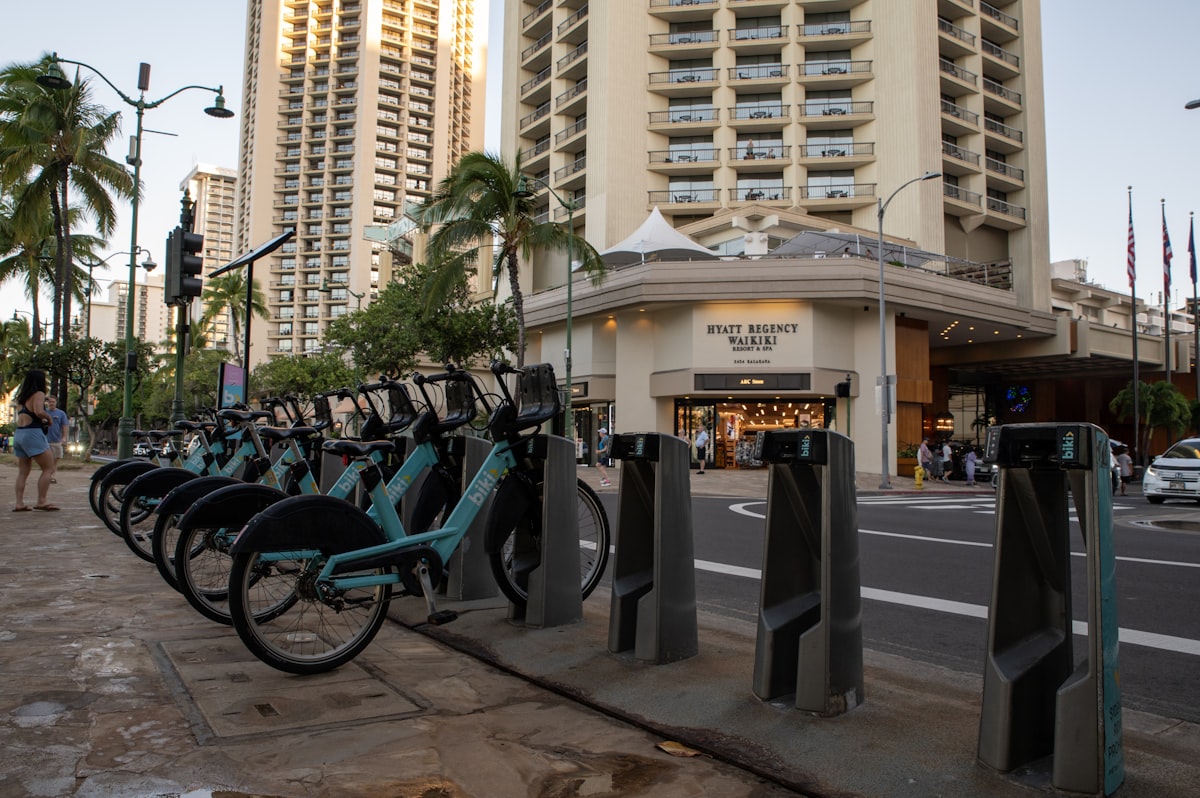
Biki bikeshare docks on a Waikiki street corner. Photo by Trac Vu on Unsplash
Beaches: different problems, not different quality
Both islands have beaches that will ruin other beaches for you. The difference is variety versus calm.
Oahu gives you range inside an hour's drive. Waikiki is gentle, shallow and packed. Kailua and Lanikai on the windward side are the postcard ones. The North Shore flips personality by season: Waimea Bay is a swimming hole in summer and a serious, dangerous shorebreak in winter when the big swells arrive. Diamond Head isn't a beach but it's the classic Oahu morning: 0.8 miles up, 560 feet of gain, and a reservation plus $5 per person and $10 per vehicle for non-residents, per Hawaii State Parks.
Maui's beaches are calmer and less crowded, which is most of the island's appeal. Kaanapali and Wailea are long, sandy and swimmable straight off the resort lawn. Makena's Big Beach is dramatic and has a shorebreak that sends people home with injuries every year, so read the signs. Molokini, the sunken crater off the south shore, is the best snorkel morning in the state on a calm day. Waianapanapa's black sand beach near Hana also requires reservations, at $5 per person and $10 per vehicle for non-residents, and it's open 7 a.m.-6 p.m., per Hawaii State Parks.

Low-rise resorts behind a calm stretch of Maui sand. Photo by Luke Scarpino on Unsplash
Honest read: if the beach is the whole point and you want to walk to it from your room, Maui wins. If you want five different coastlines in five days, Oahu wins.
Food and nightlife: this one isn't close
Honolulu is a real city with a real food scene, and Maui isn't trying to be. Chinatown, Kaimuki and the stretch along Kapahulu give you izakaya, plate lunch, malasadas, saimin and enough good ramen to argue about. You can eat well on Oahu for $15 and spectacularly for $150, and after dinner there's somewhere to go.
Maui's food is good and thinner on the ground. Paia and Kihei carry the casual end, the Wailea and Kaanapali resorts carry the high end, and prices skew up because almost everything arrives by barge. Lahaina town is coming back rather than fully back. Most of Maui gets quiet by 9 p.m., which is either the point of the trip or the problem with it.
Pro tip: On Maui, book the one dinner you actually care about the day you book your flights. The good tables in Wailea and Paia go weeks out, especially in January and July.
Traveling with kids
Both islands work. They work differently.
Maui's advantage is the setup: a condo with a kitchen, a pool, and sand you can walk to in flip-flops. That's the dominant way people stay there. In 2024, 23.9% of Maui's visitors stayed in a condominium and 50.9% in hotels, while on Oahu 70.2% stayed in hotels and only 8.7% in condominiums, per the 2024 Annual Visitor Research Report. Groceries and a kitchen change the math on a week with small kids more than any other single decision.
Oahu's advantage is that things are close together and cheap to get to. Pearl Harbor National Memorial has no entrance fee, parking runs $7 a day, and tickets for the USS Arizona Memorial program carry a $1 management fee through Recreation.gov, per the National Park Service. Add the aquarium, the zoo, a snorkel afternoon and enough shave ice to cause problems, and a week with a nine-year-old fills itself without a two-hour drive in the middle of it.
Rough rule: toddlers and naps favor Maui. Kids old enough to want a full day out favor Oahu.

Parents and two kids mid-vacation on bright sand. Photo by Niko Samik on Unsplash
If it's your first trip to Hawaii
The state's own numbers make this argument better than any opinion can. First-time visitors made up 35.4% of Oahu's visitors in 2024. On Maui the figure was 27.3%, with repeat visitors accounting for 72.7%, per the 2024 Annual Visitor Research Report.
That pattern isn't an accident. Oahu is where people go to find out what they like about Hawaii: city, surf, history, hikes, food, and the cheapest way to sample all of it. Maui is where they go back to, once they know they want seven quiet days on a good beach and will pay for them. First trip, Oahu. Second or third, Maui gets much more compelling.
What you'll actually spend
Lodging is where the gap lives, and it's a big gap. In June 2026, Oahu hotels averaged an ADR of $292 and Waikiki hotels $275, while Maui County hotels averaged $563. Inside Maui, Wailea ran $777 and the Lahaina, Kaanapali and Kapalua region ran $464. Statewide ADR that month was $384, so Oahu sits under the Hawaii average and Maui well over it, per the June 2026 Hawaii Hotel Performance Report from Hawaii's Department of Business, Economic Development and Tourism.
Day-to-day spending follows. Visitors on Oahu spent $219 per person per day in 2024 against $283 on Maui, per the 2024 Annual Visitor Research Report. Part of that is the rental car. Part of it is that when you're staying in a resort area, you eat in the resort area. If Hawaii is on the list mainly because it's warm in December, check it against the other warm December destinations first: the holiday weeks are peak on both islands.
For a full breakdown of what a Hawaii trip costs, including flights, food and the state's lodging taxes, we priced it out separately in Is Hawaii Expensive?. And if the airfare is what's actually deciding this, our guide to finding cheap flights covers the tactics that work on Hawaii routes specifically.
What's changed on Maui recently
Two things are worth knowing before you book, and both are easy to get wrong from secondhand information.
West Maui is open. The County of Maui Office of Recovery announced in July 2026 that Front Street in Lahaina would reopen to vehicular traffic on August 1, from Papalaua to Shaw streets, with Dickenson and Prison streets reopening too, after seawall and sidewalk repairs, new railings and repaving. A few blocks stay closed, Market Street and Papelekane Street among them, for ongoing work that includes the state's dredging of Lahaina Harbor, per the County of Maui. Commercial activity is returning in stages, the ʻUlu o Lele Marketplace and Kimo's among them, and the county warns that temporary closures are still possible while reconstruction continues. That was the picture in August 2026, so check the county's recovery updates close to your dates.
Second, Maui County adopted Ordinance 5909 (Bill 9) on December 15, 2025, effective the same day. It strikes transient vacation rentals from the permitted uses in the A-1 and A-2 apartment districts, ending the exemption that let so-called Minatoya List units run as short-term rentals, and it sets a deadline after which the use must cease: January 1, 2029, in the West Maui community plan area, January 1, 2031, everywhere else in the county. As of May 29, 2024, 6,208 Minatoya-listed units were operating as short-term rentals, roughly 60% in South Maui and about 36% in West Maui, and the county expects more than 6,000 of them to return to long-term residential use, per the County of Maui. Hotel- and resort-zoned properties are untouched. If you're booking a Maui condo for a trip a few years out, ask the host to confirm the unit's zoning, and read the cancellation terms on whatever site you book through, Vrbo included, before you put money down.
Maui vs Oahu at a glance
Decision factor | Oahu | Maui |
|---|---|---|
Rental car | Optional. Waikiki is walkable, TheBus and Skyline cover the island | Effectively required for the whole stay |
Beaches | Most variety: town, windward, North Shore surf | Calmest and least crowded, best resort-front swimming |
Food | Full city scene, wide price range, good cheap eats | Good but limited, skews expensive, quiet after 9 p.m. |
Nightlife | Real bars, live music, late kitchens | Resort lounges and early dinners |
With kids | Short drives, cheap attractions, hotel-heavy | Condo kitchens and pools, more driving |
First trip to Hawaii | Better. 35.4% of visitors are first-timers | Better second trip. 72.7% of visitors are repeat |
Hotel cost | Averaged $292 ADR in June 2026 | Averaged $563 ADR in June 2026 |
Biggest drawback | Crowds and traffic, especially Waikiki and the H1 | Cost, and the amount of time you spend in a car |
Choose this if | You want one island that does everything, on a normal budget | You want a quiet beach week and will pay for it |
First-time and repeat visitor mix from Hawaii DBEDT's 2024 Annual Visitor Research Report; June 2026 island ADRs from the same department's Hawaii Hotel Performance Report.
The verdict
Pick Oahu if: it's your first trip to Hawaii, you'd rather not rent a car, you care about food, you want history and hiking and surf without long drives, or the budget is tight and you'd rather have more nights than nicer ones. Oahu is also the pick for a group that wants different things, because it can keep a surfer, a museum person and a nightlife person happy in the same week.
Pick Maui if: you've already done Oahu, you want the beach to be the whole point, you don't mind driving, you're traveling as a couple, or you want a condo with a kitchen and a pool and no reason to leave it. If quiet is the actual goal, it's Maui. Oahu can't give you that.
And Kauai, the island people ask about third? Greener and more dramatic than either, more car-dependent than Maui, quietest after dark: a better third Hawaii trip than a first.
Or do both
A two-island trip is easy here, and it's what a lot of repeat visitors do. Honolulu and Kahului are one short interisland hop apart, flown many times a day by carriers including Hawaiian Airlines, in less time than the drive to Hana.
The version that works: three or four nights on Oahu first, city and history and food while you're still on mainland time, then four nights on Maui doing nothing. Fly into Honolulu and out of Kahului so you're not backtracking. Zenvoya can put that multi-city version together in one conversation, interisland hop included, and book the flights, hotels and experiences on both islands.
The version that doesn't work: two nights on each island. You'll burn a full day of a week-long trip in airports and rental car lines.
Ready to pick your island?
Decide the rental car question first. Everything else follows from it. Don't want to drive on vacation? Oahu, and you can stop comparing. Driving is fine and quiet is the goal? Maui, and the only thing left to pick is the coast.
Once you know the island, map it out with Zenvoya's AI travel agent: flights, hotels and experiences together, and it stays with you if a flight moves mid-trip.